

When everything reaches the front desk at once
A family is waiting for room keys. The phone rings while a front desk employee answers a billing question. The caller only wants to know where to park. That information is part of the service, but at this moment it interrupts another task.
Situations like this offer a useful starting point for AI in hotels. Answering recurring questions, capturing requests clearly, and preparing information for the next shift are practical applications. Whether they pay off depends on the interruptions the hotel actually experiences, call volumes, and the follow-up work that remains.
A week of simple observations often provides more useful evidence than an impressive product demonstration. Which requests recur? When do calls go unanswered? How often does someone have to look up information in two systems? This picture helps the hotel decide whether to begin with phone calls, website chat, or assistance for employees.
What an AI assistant may answer and what it may do
Three types of work need separate consideration. An answer draws on approved information, such as breakfast hours. A lookup checks a current state, such as room availability for a particular night. An action changes something: it extends a reservation, creates a work order, or sends a binding confirmation.
The requirements change at each step. An outdated breakfast time causes frustration. An unauthorized reservation change can also create costs and further mistakes. For each request type, the hotel should define how far automation is allowed to go.
Agents can connect to other applications through tools and external interfaces. ElevenLabs, for example, supports calls to external application programming interfaces (APIs). The practical work lies in the specific connection: which request is sent, what response comes back, and under what conditions may the next step proceed?
This does not require a hotel to replace its entire software environment. Connecting existing systems selectively may be more appropriate. The article on planning software and integrations examines that decision in greater detail.
One extra night reveals the requirements
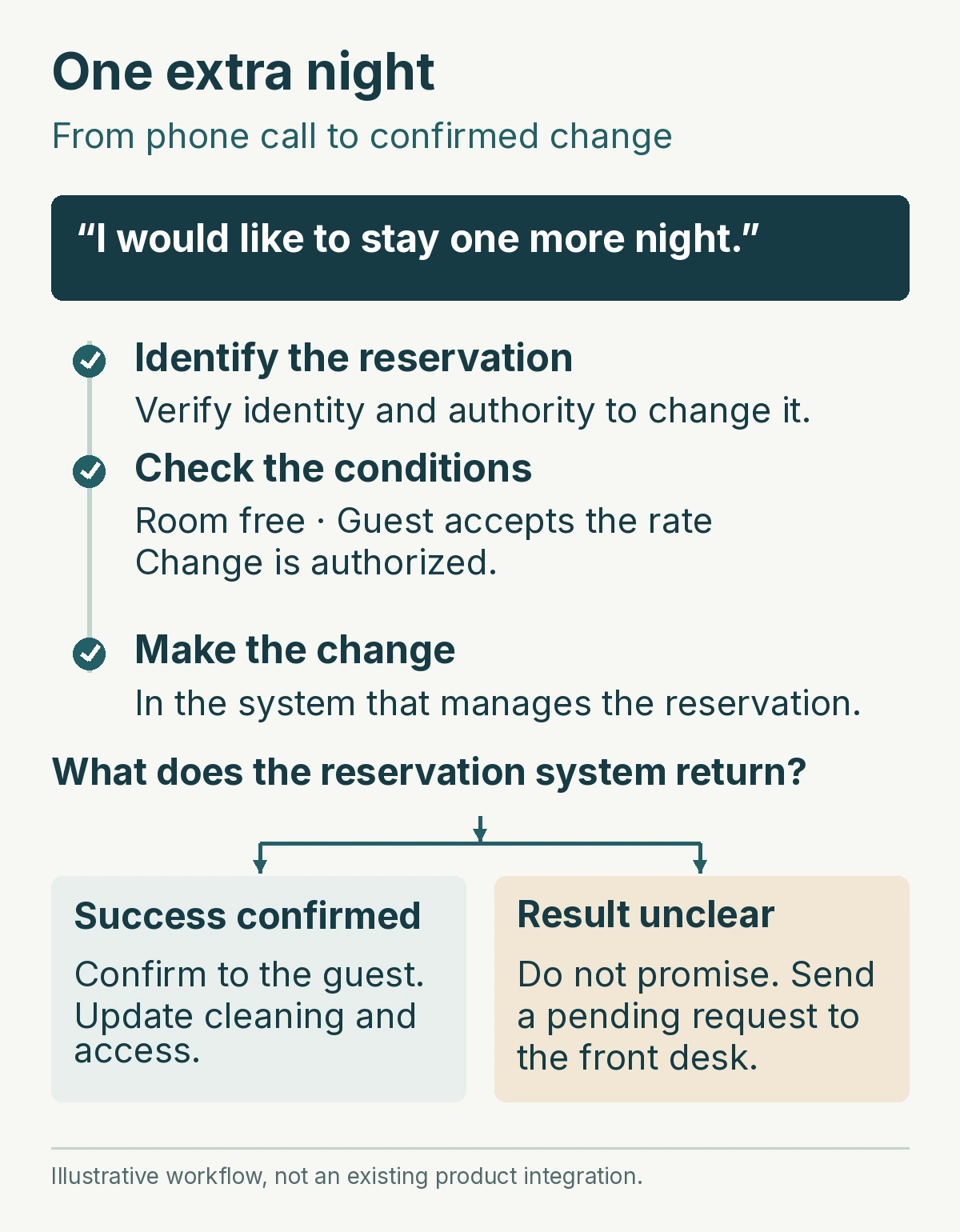
A hypothetical case runs through this article. A guest calls in the evening to extend a stay by one night. The AI understands the request, checks the new departure date, and summarizes it accurately. So far, the conversation has gone well.
Several questions still need answers before the hotel can agree. Can the reservation be securely linked to the caller? Is the same room available, or would the guest have to move? What rate applies, and does the guest accept it? Do the booking conditions require front desk review? Giving a last name and room number should not be treated as universal authorization to make changes.
If the required information and permissions are available, a properly configured workflow can make the change in the reservation system. Confirmation to the guest follows the successful response. If the interface does not return a result, the guest receives a clear explanation of the pending status, while the front desk receives an open request with the details already established.
The work then continues within the hotel. Departure cleaning moves to another day, access may need to remain valid longer, and any other affected services require review. The article on changes to confirmed reservations explains these consequences. For AI deployment, the important point is that the change can be traced and unfinished follow-up tasks remain visible.
AI hotel phone calls: what ElevenLabs illustrates
ElevenLabs offers an example of how voice assistants are developing. Reception, introduced on September 16, 2026, is designed for small businesses. It answers calls, provides information, and schedules calendar appointments. This does not establish a ready-made connection to hotel availability or reservation conditions. Each hotel use case needs its own assessment.
ElevenAgents Architect followed on October 6. According to the provider, it helps configure and improve agents and prepares changes as reviewable drafts. At the source review date for this article, the feature is in Alpha. Hotels can consider the development without treating it as evidence of a proven hotel deployment.
In everyday use, much depends on what happens when the assistant reaches a limit. ElevenLabs documents transferring an active phone call to a person. The available transfer methods depend on the telephony connection. Practical testing therefore needs to include the hotel's own number, staff availability, and phone system.
For the extension request, the front desk could take over when a special rate requires review. Ideally, the requested date and findings so far are already available. If nobody can answer, the guest needs a clear explanation of the next step. Promising a callback only makes sense if someone on duty is responsible for making it.
Hotel staff should call the system themselves and try awkward situations: background noise, an interruption halfway through a sentence, a corrected date, or an explicit request to speak to a person. Voice quality is experienced in conversation. A short audio sample says little about these situations.
Chatbots and multilingual answers need maintained information
A parking question may arrive by phone, chat, or message. The answer should be consistent for the guest. The hotel therefore needs to decide which information source is authoritative and who maintains it. Opening hours, directions, and descriptions of services can be prepared in advance. Current room availability and individual booking conditions require different data.
ElevenLabs can use a knowledge base built from documents, web pages, and text. Selecting the material deserves care. An old events brochure, an internal note, and current guest information should not be treated as equally authoritative without review. Every addition needs a clear purpose. Time-limited information should have a period of validity and an owner.
Multiple languages extend the potential benefit and the work needed to verify answers. ElevenLabs supports switching through an agent's language detection tool. The hotel still needs to check how reliably the configuration handles its guests' names, dialects, place names, and numbers.
Conditional statements make particularly revealing tests. “Parking subject to availability” must not become a guaranteed parking space in another language. Similarly, “extension requested” must not turn into “extension confirmed.” Test these distinctions in the languages the hotel actually uses most. A long list of supported languages cannot replace that work.
For email, a measured starting point is to let AI draft the response for an employee to review. Recurring information gaps then become visible before the same content is sent to guests automatically.
Preparing conversations for internal use can also help. Small distinctions matter. A guest saying, “I could wait until tomorrow if nobody has time today,” should not automatically become “Guest requests service tomorrow” in the shift handover. The first statement offers a fallback, while the second expresses a firm preference. A useful summary preserves that uncertainty and shows what still needs clarification. Names, dates, and promised responses deserve particular attention during review. Drafts for employees are often easier to limit in an initial deployment than commitments sent to guests without review.
Deciding which data an agent can access
Answering a question about breakfast hours requires no access to guest passports, invoices, or internal personnel files. Even the extension request can use a limited set of data: the relevant reservation, permitted terms, and the availability information needed. General access to shared folders is an unsuitable default for this task.
Access checks belong in the connected systems. An instruction telling the agent not to disclose confidential information cannot replace technically restricted permissions. For changes, the request, approval, and result should remain traceable. The article on roles and access rights in accommodation operations explains the underlying approach.
For Swiss businesses, the Federal Data Protection and Information Commissioner confirms that data protection law also applies to AI-based processing. Before deployment, the hotel therefore needs to address the processing purpose, information provided to the people concerned, participating service providers, and treatment of recordings. The specific legal requirements also depend on the use case and data involved.
Storage and model training are separate questions. Assuming that every conversation automatically trains a model is no more reliable than making the opposite promise. In its Zero Retention Mode documentation, ElevenLabs states that agreements with external language model providers prohibit those providers from training on customer content. This is not a blanket statement about every use of data across all products involved.
ElevenAgents also allows configuration of conversation data retention periods. The hotel should examine settings alongside contracts. Are audio, transcript, and summary all needed? Who can access them? When are they deleted? What copies are created in other applications? A concise summary with the necessary work request may serve the operation better than keeping a complete conversation indefinitely.
Start with a defined use case
An initial deployment should have a clear information base and manageable consequences. General questions about arrivals outside front desk hours are one example. Individual access credentials should remain within a designated, protected process. Reservation changes can initially be handed to employees.
Before launch, define the permitted answers, handoff points, and conditions for stopping an automated action. ElevenAgents testing features include checks on responses and tool calls. Real test calls using the intended phone configuration are also needed. Whether a lookup was triggered correctly and whether a guest understood the answer are different questions.
The hypothetical stay extension should produce these results:
- No additional night is promised when availability is missing.
- A corrected departure date is clearly reconfirmed before a change.
- An interface timeout creates a pending review rather than an invented success message.
- Sending the same request again does not create a second reservation change.
- A handoff includes the necessary details and can actually be accepted by an employee.
After a call, post-call webhooks can send transcripts, analysis, and metadata to a configured endpoint. The hotel needs a usable work item from this transfer. The end of a call alone does not establish that an extension has been processed. The article on guest requests, tasks, and follow-up explores how requests reach a verified conclusion.
Measure the time saved, including follow-up work
A simple illustrative calculation helps put sales claims in perspective. Suppose a hotel receives 250 suitable calls a week, each previously taking two minutes of employee time. That totals 500 minutes. If 25 of these calls subsequently need four minutes of follow-up, subtract 100 minutes. Allow another 60 minutes for maintaining information and 60 for quality checks. The calculated reduction in workload is then 280 minutes, or four hours and 40 minutes.
Every number is an assumption chosen for this example, not a measured result or a provider forecast. Software, telephony, setup, and ongoing support must be costed separately. Longer conversations or more follow-up work change the result.
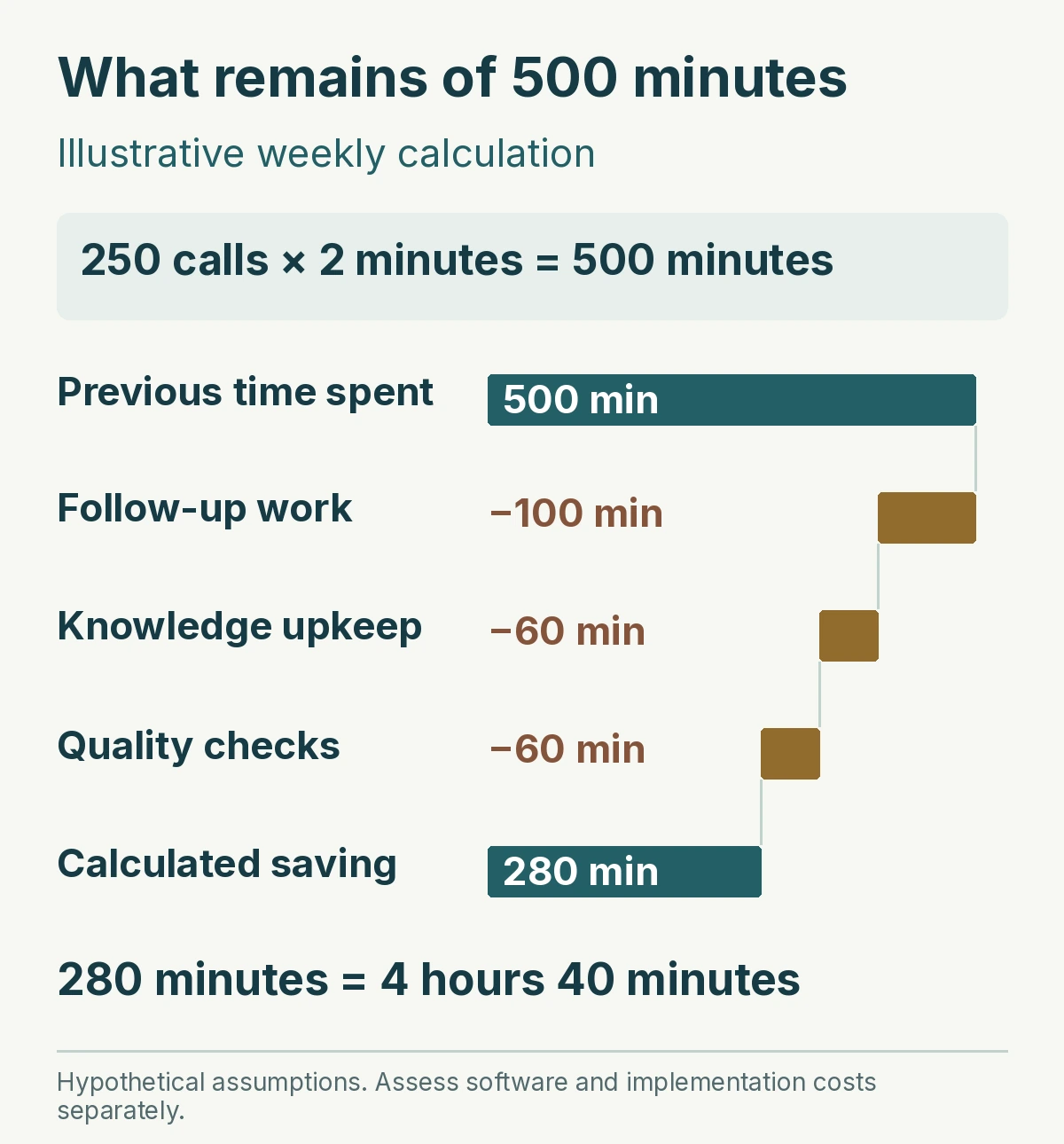
The time saved cannot automatically be removed from a staff schedule. When it consists of many short interruptions, its value may be better concentration and shorter waits for guests at the desk. Alongside minutes, the review should therefore track incorrect promises, repeat contacts about the same request, and successfully completed handoffs.
Reviewing each request type separately helps. A high proportion of correct answers about breakfast and parking can conceal a small number of consequential errors in reservation changes. For every approved task, the hotel should be able to see how often it was completed successfully and why employees had to intervene. Compare similar operating periods where possible. A quiet week with few arrivals says little about performance during a trade fair. Seeing these differences supports a decision about whether to add the next use case or improve the current configuration first.
Choosing the next step for the property
A hotel with many unanswered routine calls has a different starting point from one spending most of its time on multilingual emails. Let the operational problem determine the choice. A limited deployment with maintained information and reliable handoffs provides a useful basis for deciding what to add next.
Oprivia's area of focus is the work that follows: responsibility, handling requests, evidence, and verifiable results. A specific connection to an AI provider would need to be agreed and assessed for the operation concerned. The stay extension described here is a planning example, not an existing Oprivia integration with ElevenLabs.
Sources and Notes
Editorial and professional context
Sources reviewed on October 8, 2026. This article combines current primary sources with editorial recommendations for hotel operations. The stay extension case and all figures in the workload calculation are hypothetical examples. Provider documentation supports the described capabilities, not their suitability or results at an individual hotel.
External professional sources
- ElevenLabs: Reception: Product announcement dated September 16, 2026, updated September 22. Business calls and calendar appointments.
- ElevenLabs: ElevenAgents Architect: Announcement dated October 6, 2026. Assistance with agent configuration, in Alpha at the review date.
- ElevenLabs: Tools: Documentation of tools used to connect agents to other applications.
- ElevenLabs: Transfer to number: Call transfers and differences between telephony configurations.
- ElevenLabs: Knowledge base: Supported information sources for agents.
- ElevenLabs: Language detection: Configurable switching between supported languages.
- ElevenLabs: Agent Testing: Testing agent responses and tool calls.
- ElevenLabs: Post-call webhooks: Transferring conversation data after a call.
- ElevenLabs: Retention: Retention settings for transcripts and audio.
- ElevenLabs: Zero Retention Mode: Product-specific retention and statements concerning external language model providers.
- FDPIC: Data protection law and AI: Official guidance on the applicability of Swiss data protection law.
Oprivia sources
- Serviced apartment software and integrations: System selection and connections between existing applications.
- Changes to confirmed reservations: Consequences for cleaning, access, and other operations.
- Guest requests through to resolution: Tasks, follow-up, and verifiable completion.
- Roles and access rights: Restricted permissions in accommodation operations.
Scope and limitations
This is not a product test, individualized legal advice, or confirmation of an existing Oprivia integration with ElevenLabs. Telephony, system access, privacy, and contract terms require assessment for the intended operation. Features, availability, and product status may change. Oprivia is not presented as a reservation system or AI phone service provider.