

A guest drives to the hotel expecting free parking. That is what the booking site said. At reception, he learns that parking now costs CHF 18 per night. The amount is correct on the hotel website, and the internal price list has been updated. His stay still begins with a disagreement.
The example in this article is fictional. Its operating problem is worth examining because one change can affect several places, each with a different update process. Reception eventually has to establish what the guest was told, which conditions apply to his reservation, and who may approve an exception.
Our article on Google Vacation Rentals examined an additional route to direct bookings. This follow-up considers a question that reaches beyond any single sales channel: how can hotel information remain reliable when websites, booking platforms, pre-arrival messages, and employees all use it?
A parking change involves more than editing a sentence
“Parking available” answers only part of a guest's question. Price, advance reservation requirements, vehicle height limits, and distance from the hotel can matter just as much. A short listing and a detailed arrival guide may use different wording. Their facts need to agree.
In our example, the hotel first establishes the new condition: a space will cost CHF 18 per night from November 1. The responsible manager reviews the agreed terms before deciding how to treat reservations already confirmed. Employees and automated messages need that decision before they can give a dependable answer.
Several tasks follow. Someone updates the approved information. Marketing or distribution staff amend the relevant channels. Reception receives usable guidance for questions, while existing bookings are checked to determine whether guests need a message. Only then can the team assess whether the change has reached everyday operations.
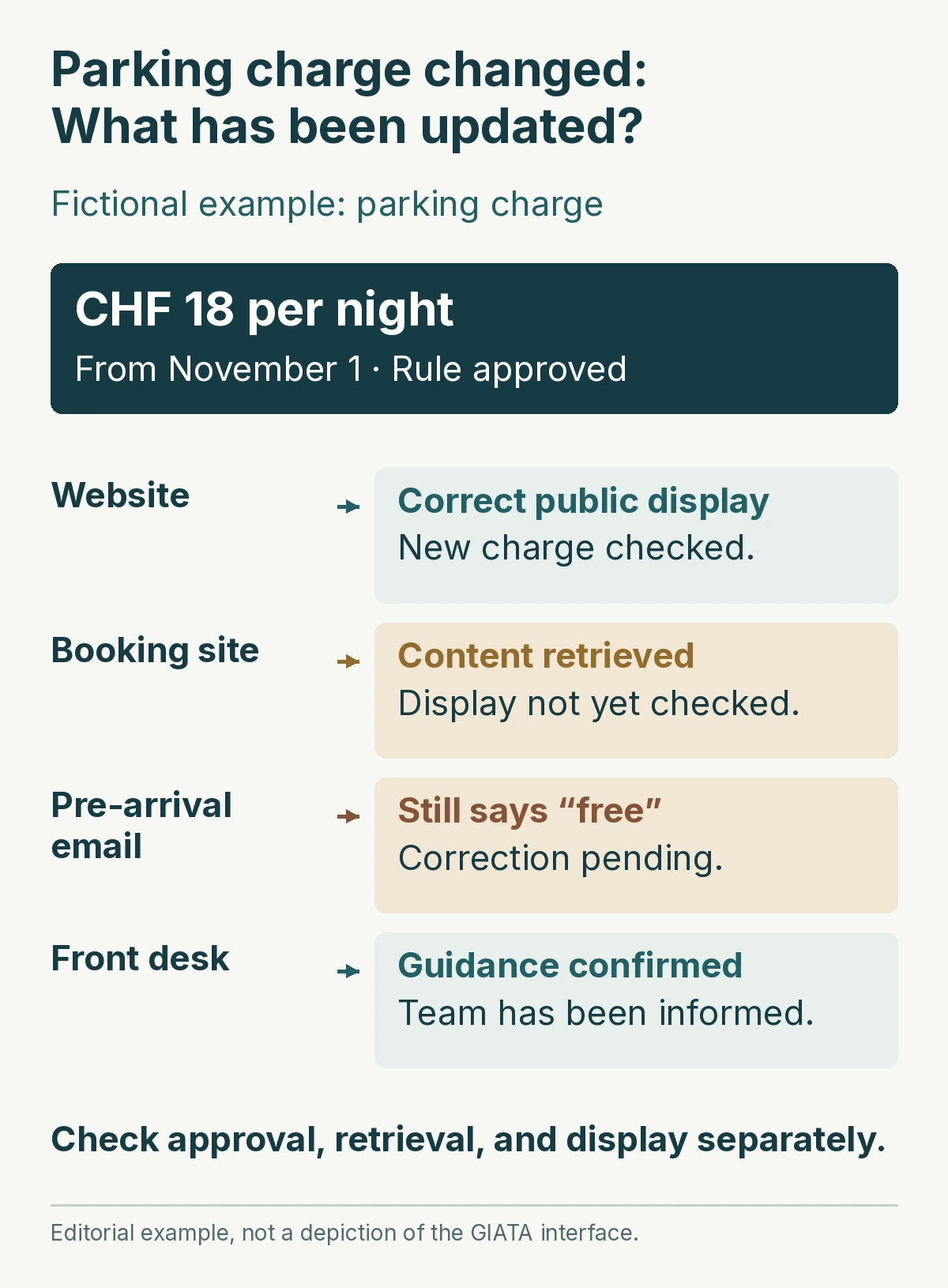
What the maintained source needs to contain
A shared document may be enough for a small property if ownership and use are clear. Several hotels, many distribution partners, and multiple languages create a different workload. Structured management becomes more useful as these dependencies grow.
For frequently requested services, a short record should identify the approved fact, where it applies, its effective date, and the person responsible. Relevant channels and, when necessary, an expiry date complete the picture. A seasonal restaurant closure, for example, needs a scheduled review before reopening.
This keeps factual conditions distinct from marketing language. “Arrive and unwind” might work as a heading. The information beneath it still needs to explain where guests can park and whether they must reserve a space. Channel-specific wording can change without changing the terms.
Technical data models recognize some of these distinctions. Booking.com’s facilities documentation separates property-level and room-level facilities and supports features with additional parameters. For an editorial team, the practical implication is straightforward: record a hotel fact precisely enough that its meaning survives transfer to another system.
What GIATA does
GIATA supplies hotel data to the travel industry. Its GIATA Drive product centralizes hotel and room information, images, and fact sheets for distribution to connected sales partners. A monitor provides information about partner access. It is therefore one option for properties maintaining content across many outlets.
An assessment should begin with the hotel's main channels and required fields. A large partner network does not, on its own, establish whether the relevant parking details, room images, or service conditions can be sent through the required connection. Setup work, ongoing maintenance, and correction handling belong in the decision as well.
A content request does not confirm a public update
The GIATA content distribution guide clarifies that retrieval does not confirm a visible update at the destination. Different sources and processing schedules can still produce discrepancies.
In the parking example, the discrepancy remains open until someone checks the updated listing. Until then, a named person retains responsibility for the correction.
Separate the property offering from the room and the reservation
A hotel can serve breakfast without including it in every rate. It can also have a sauna that is available only during particular hours. Combining these facts into a blanket answer creates avoidable misunderstandings.
The Expedia content documentation distinguishes amenities at property, room, and rate-plan level. Even for staff who never work with an API, that is a useful way to check information.
When a guest asks whether breakfast is available and whether it costs extra, an employee is answering two different questions. The first can be answered from approved property information. The second requires the terms of that guest's reservation. A chatbot or telephone assistant needs the same distinction before providing a binding answer.
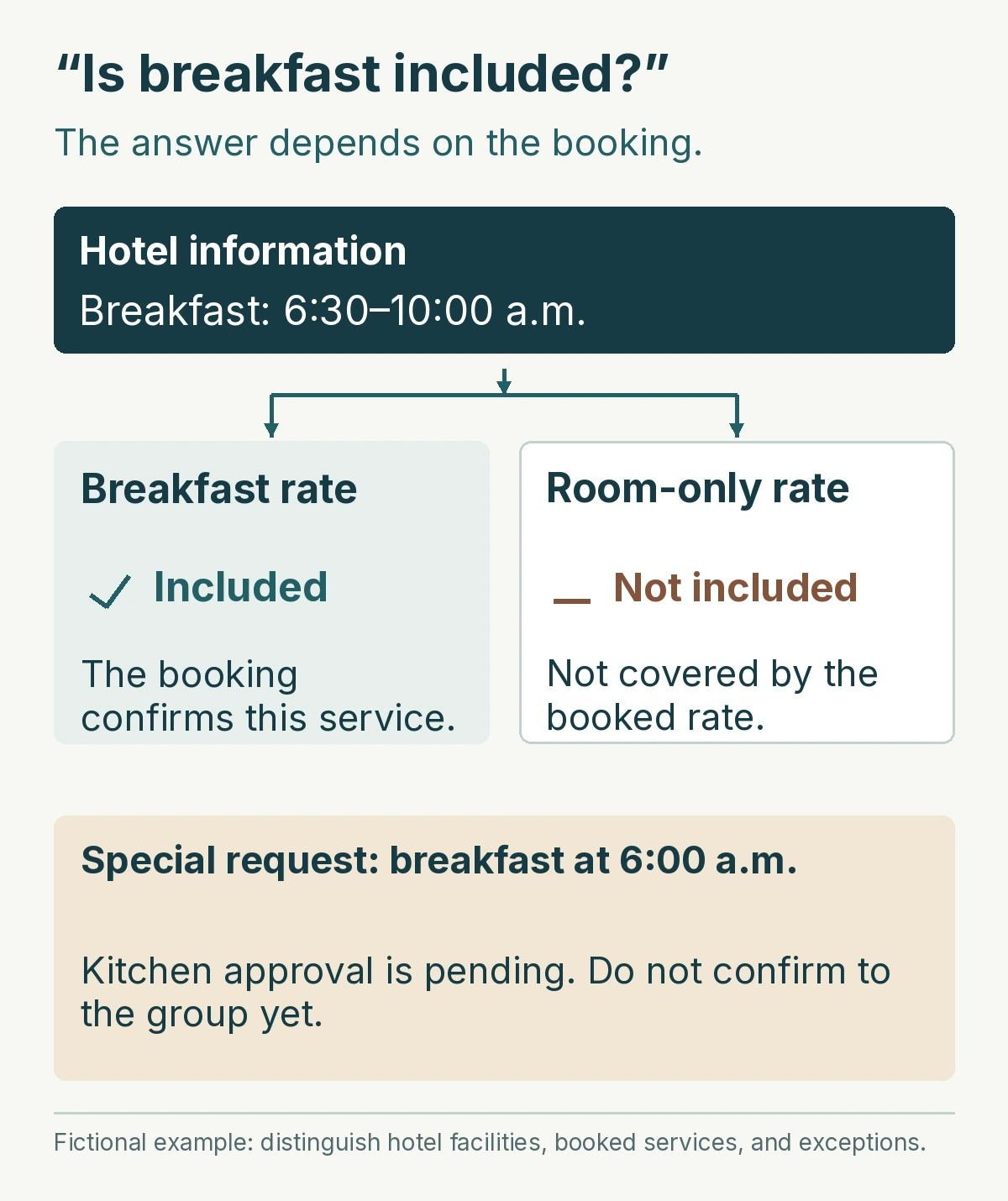
Individual arrangements need their own context. An early breakfast promised to a tour group should not become the hotel's general breakfast time. The relevant staff still need to know which group the promise concerns and whether the kitchen has confirmed the arrangement.
Translations and images need an informed review
A translation can lose a condition in just a few words. “Breakfast at an additional charge” must not turn into “breakfast included.” If a service is available only during the summer season, that limit also needs to remain clear. Such details affect what a guest expects. Fluent wording alone is not an adequate check.
A practical editorial approach is to approve the underlying fact first, then review the required language versions against it. When a condition changes, flag the affected translations. The team can then see which versions are current and which still need attention.
Photos require similar care. A renovated bathroom belongs with the appropriate room category. The largest room is not necessarily representative of every category. Recording when an image was taken, what it shows, and its permitted use helps staff select it correctly, particularly when several people share the same media collection.
Expedia Group's content policy requires accurate information and updates to material changes. It also prohibits misleading portrayals created with AI editing. The practical point is that an attractive image still needs to represent what guests can expect. Invented furnishings or an improved view can undermine that purpose.
Reception needs a usable version of the new information
Return to the parking change. After the public listing has been updated, a pre-arrival message may still contain the old sentence. A saved response at reception might do the same. Reviewing public listings alone misses these points of contact.
A short list of actual uses helps: the hotel website, main booking platforms, Google Business Profile, booking confirmation, pre-arrival email, digital guest information, and internal response templates. Keep it limited to channels the property really uses. A rarely used distribution route should not receive more attention than the messages guests receive every day.
Google’s guidance for managing hotel details provides a direct way for verified hotel profiles to edit services and amenities. These direct editing routes also need an assigned owner. Otherwise, two people can correct the same fact through different paths and introduce another inconsistency.
Prioritize unresolved differences by their effect on the guest. An old gallery label is usually less urgent than incorrect driving directions, an unavailable service, or a wrong charge. The responsible person should record what remains inaccurate, how affected guests will be informed until it is fixed, and when someone will check again.
Existing reservations require a separate decision
For confirmed reservations, the hotel reviews individually agreed services before applying updated information to those guests. That review informs the operating decision on how the change will be handled. This article does not infer a general legal rule for changing prices.
Operationally, reception should not have to negotiate the question from scratch during every conversation. After its review, management in our example might decide to preserve free parking for a defined set of existing reservations. That decision belongs with the relevant stays. A vague instruction that “exceptions are possible” simply leaves the next shift to resolve the issue.
If the situation becomes a guest request, the responsibilities and feedback described in our guide to guest requests provide a useful structure. Reservation changes remain a separate process when reserved services or agreed conditions are affected.
Start with one recurring problem and check the result
Choose a subject that regularly generates questions or discrepancies. Parking, breakfast, or late arrival can work if the property has a real problem in that area. The team records the approved information, its main uses, and the current owner. It then follows one genuine change through all relevant steps.
Check the result from the guest's perspective. What answer appears on the booking site? What does the message say? What happens when the guest calls? If the answers differ, first locate the cause. It may be the original fact, its transfer, a translation, or a condition specific to the booking.
A simple review should also include a handover. Ask a colleague who did not make the change to respond to the same guest question using the available information. This reveals whether the instruction works beyond the person who wrote it. If the colleague has to reconstruct the decision from several messages, the record still needs work.
Useful measures include the number of discrepancies found, time to a confirmed correction, and repeated questions about the selected topic. A decline can be encouraging. Occupancy and guest mix should be considered before attributing a financial saving to the change.
The roles of the systems involved should remain manageable. A hotel content platform can maintain and distribute information. Operating tasks, approvals, and evidence concern implementation inside the property. Oprivia focuses on such organizational workflows after booking. This article does not claim an existing GIATA integration or partnership. Our software-stack guide discusses how responsibilities can be divided between existing systems.
For the guest, success is concrete. The information used to plan the trip matches the answer received on arrival. When an exception is needed, an authorized person can make the decision with the relevant facts in front of them.
Sources and Notes
Editorial and professional context
Sources checked October 8, 2026. Provider functions are described using publicly available primary sources. The parking case and breakfast examples are fictional editorial illustrations. Process recommendations are analysis, not documented customer results.
External professional sources
- GIATA Drive: Product scope for hotel information, images, and distribution.
- GIATA DRIVE Content Distribution Guide: Meaning of retrieval indicators and limits of display on partner channels.
- Google: Manage your hotel’s details: Direct maintenance of services and amenities in a hotel profile.
- Booking.com: Managing Facilities API: Distinction between property-level and room-level facilities.
- Expedia: Content reference lists: Amenities at property, room, and rate-plan level.
- Expedia Group: Partner Provided Content Policy: Requirements for accurate content and limits on misleading AI editing.
Oprivia sources
- Google Vacation Rentals: Set Up Direct Bookings Properly
- When a Confirmed Booking Changes: What Operations Must Update
- Guest Requests in Vacation Rentals: From Ticket to Verified Closure
- Serviced Apartment Software: Planning the Right Stack and Integrations
Scope and limitations
This article does not evaluate a specific GIATA proposal or document a product test, partnership, or integration with Oprivia. Channel coverage, supported fields, permissions, and update paths need to be verified for the intended use. No pricing, legal entitlement, search-visibility guarantee, or promised saving is inferred.