
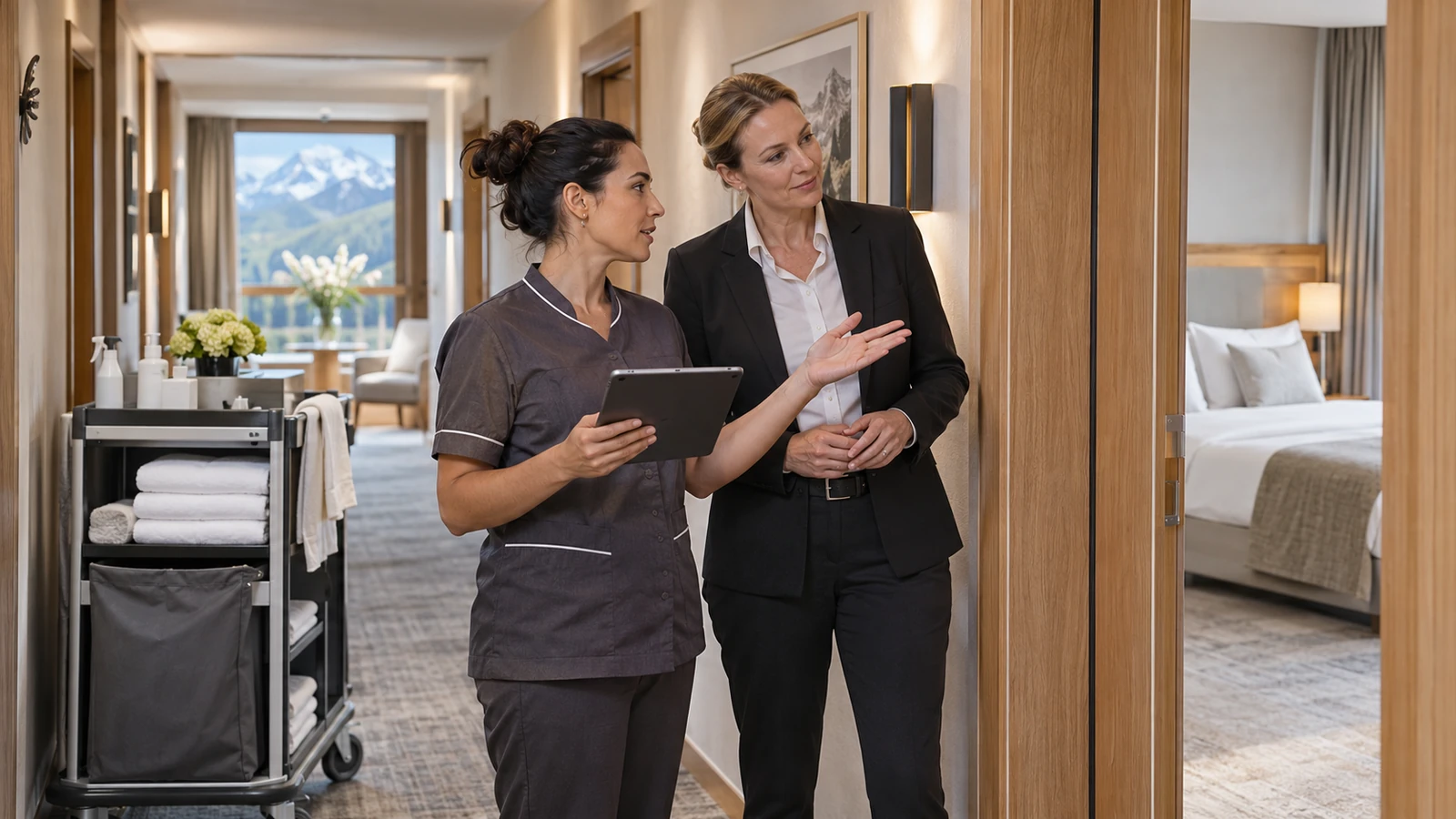
Which technology should your hotel invest in next? This guide connects eight practical examples with their requirements, limitations, and costs. Learn how to define the workflow, evaluate a limited deployment, and distinguish additional team capacity from actual cash savings.
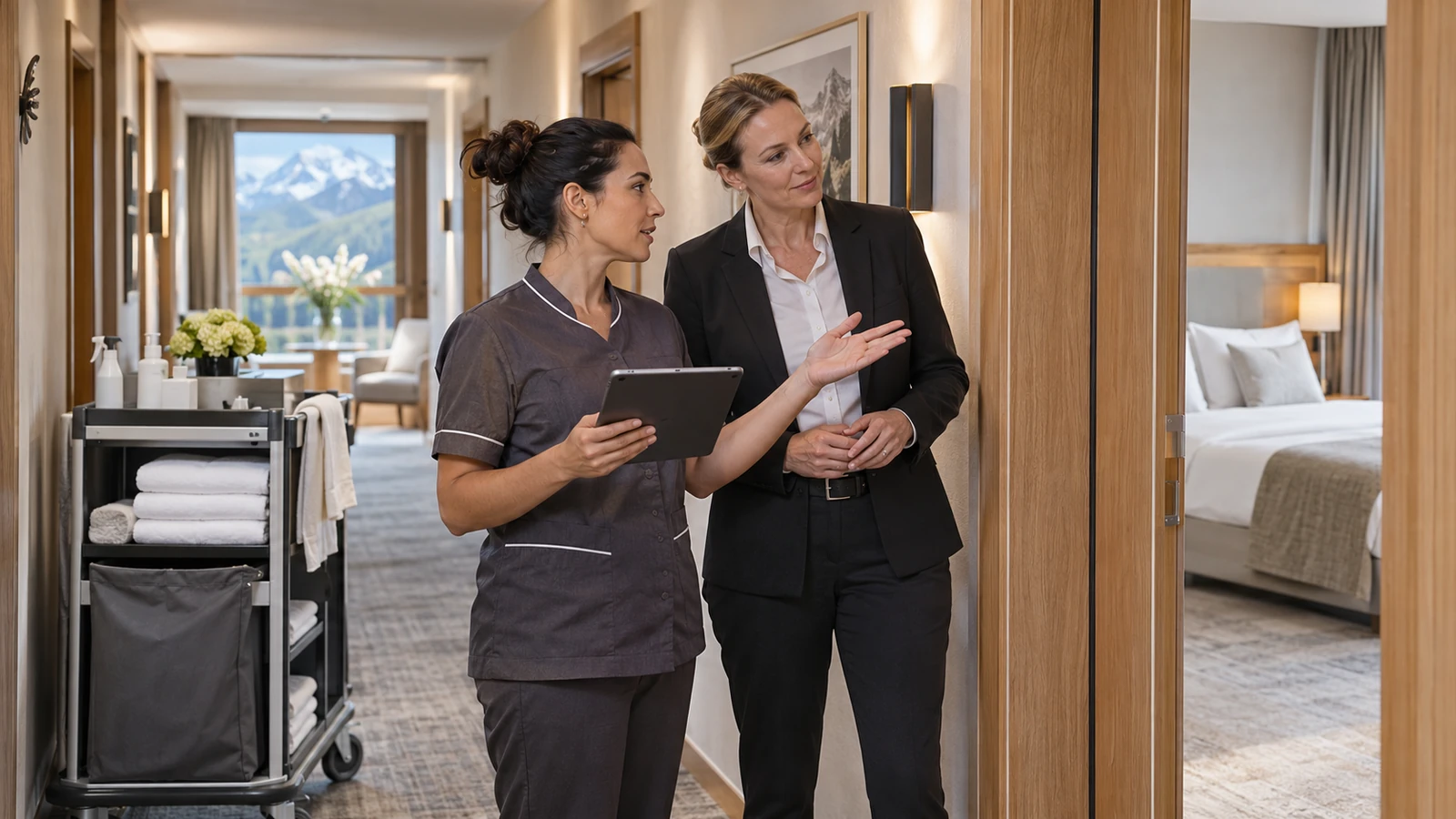
Start with the operational bottleneck
Imagine a hotel with 60 rooms, a breakfast buffet, and several floors. Front desk staff repeatedly call housekeeping to check room readiness. The kitchen throws away food, while the maintenance team has little visibility into consumption by area. This is a hypothetical planning example. Which investment should come first? The answer depends on workload, the consequences of errors, and the systems already in place. A hotel without a kitchen does not need kitchen waste analysis; a well-run housekeeping operation may gain little from another task app.
The eight products below are documented market examples. Their inclusion does not imply independent product testing or an Oprivia integration. The selection criteria, implementation advice, and evaluation measures are editorial recommendations.
Design the workflow, then automate selected steps
Technology can help build a better process. AI can organize existing instructions, draft checklists, or highlight recurring problems. It cannot reliably infer missing responsibilities or quality standards from an operation. The responsible people need to review its suggestions and establish clear rules. Otherwise, automation can repeat existing errors faster and more frequently.
For each workflow, establish what starts it, who takes ownership, what result is due when, and who verifies completion. A room being cleaned, inspected, and released for a guest can represent three different states. Likewise, answering a message does not mean the requested repair has been completed.
Reservation data, room status, and operational tasks need clear ownership. Our guide to choosing software and integrations explains system responsibilities in more detail. Also check network coverage, staff devices, access permissions, support, and fallback procedures. An advertised integration needs to work with your actual system configuration, including common exceptions.
Make rooms ready on time and verify the result
Flexkeeping: plan and coordinate cleaning
Flexkeeping Automated Cleanings is an additional feature that schedules cleaning through rules based on reservation and room data. Weighted tasks support workload allocation, while manual adjustments remain possible.
Potential benefit: Fewer daily lists and room-status calls.
Limitations: Incorrect data and unclear release decisions remain sources of error. Special requests still need to reach the right team.
Costs: The Flexkeeping FAQ describes a setup fee and monthly subscription based on room count; request a quote for additional features and integration scope.
Evaluation: Track planning time, on-time room readiness, and repeat cleaning at comparable occupancy. Faster scheduling has little value if room quality deteriorates.
Kärcher KIRA CV 50: vacuum suitable floor areas
The Kärcher KIRA CV 50 is an autonomous commercial vacuum with mapping, obstacle detection, and cleaning reports. Suitable corridors or conference areas may offer a practical starting point.
Potential benefit: Automate part of a repetitive vacuuming workload.
Limitations: Preparation, transport between floors, emptying, interruptions, and follow-up work remain. Beds, bathrooms, and room inspections are separate tasks.
Costs: Equipment, setup, consumables, maintenance, and remaining operator time. Batteries and a charger must be budgeted separately for the reviewed Swiss version.
Evaluation: Measure net staff minutes per area cleaned to an accepted standard. Rated floor coverage does not establish an equivalent staffing saving.
RapidEye: test photo inspections with human checks
RapidEye describes photo analysis integrated with Apaleo that can flag visible cleaning issues, damage, or missing items. According to the provider, this integration does not automatically change the Apaleo room status.
Potential benefit: Identify issues for further inspection.
Limitations: Camera angle, lighting, and image coverage constrain the result. A photo without a flagged issue is not proof of hygiene and should not trigger an unchecked room release.
Costs: Clarify inspection volume, data storage, setup, and time spent taking photos and reviewing results.
Evaluation: Run a limited pilot with human inspections of a sample. Include rooms rated as having no issues so that missed defects become visible. Compare valid findings, false alarms, missed problems, and total inspection time. Define photo positions, authorized access, and retention periods in advance. Images should exclude people, identity documents, payment records, and access codes. Avoid personal belongings wherever possible. Responsibility for releasing the room must remain clearly assigned.
Connect guest service with access
HiJiffy: answer frequent questions reliably
HiJiffy offers website chat, centralized guest communication, and PMS-connected workflows depending on the plan. Approved information about breakfast, parking, and arrival makes a manageable starting point.
Potential benefit: Faster answers to standard questions.
Limitations: Content maintenance, corrections, and handoffs to staff still take work. Creating a task does not prove the service was delivered.
Costs: Subscription, setup, required channels, and internal administration.
Evaluation: Measure correctly resolved requests and handling time, including rework. The guide to AI in hotels covers permissions and human handoffs in more detail.
Vingcard: fit the digital key into the arrival process
Vingcard Mobile Access provides smartphone access through different app options. The portfolio also includes wallet keys; compatibility depends on the lock, reader, software, and phone.
Potential benefit: Less work issuing and replacing keys.
Limitations: Registration, payment status, and room release are separate requirements. Guests without compatible phones and system outages need a tested fallback.
Costs: Locks, installation, licenses, integration, and support. The upgrade documentation explains that some models need license activation or a hardware upgrade.
Evaluation: Count successful first entry and support cases per 100 eligible arrivals, rather than app downloads.
Match energy and water controls to the building
Honeywell INNCOM: adjust room climate to actual use
Honeywell INNCOM Direct combines thermostats, sensors, connectivity, and remote visibility for guestroom climate control. Occupancy-based settings are intended to reduce unnecessary heating and cooling.
Potential benefit: Lower consumption where the equipment and settings are suitable.
Limitations: A sold room whose guest has briefly left requires different treatment from an unsold room. Account for sleeping guests, humidity, and temperature recovery time.
Costs: Hardware, installation, commissioning, and ongoing platform costs.
Evaluation: Compare weather- and occupancy-adjusted consumption alongside comfort complaints. Do not apply HVAC savings percentages to the entire hotel energy bill. A short software pilot cannot establish performance across seasons.
WINT: detect water losses and act on alerts
WINT analyzes water use, detects unusual patterns, and supports automatic shutoff where the installation allows it. Metering points and areas that can be isolated must fit the building.
Potential benefit: Discover unnoticed losses sooner.
Limitations: Kitchens and laundries can have legitimate overnight consumption. Alerts need an available owner and clear intervention rules.
Costs: Meters, valves, professional installation, monitoring, and maintenance.
Evaluation: Track unexplained baseline consumption, alert quality, and response time. Treat a potentially prevented water-damage incident separately as risk reduction, not guaranteed monthly savings.
Use kitchen data to change decisions
Winnow: evaluate food waste alongside purchasing
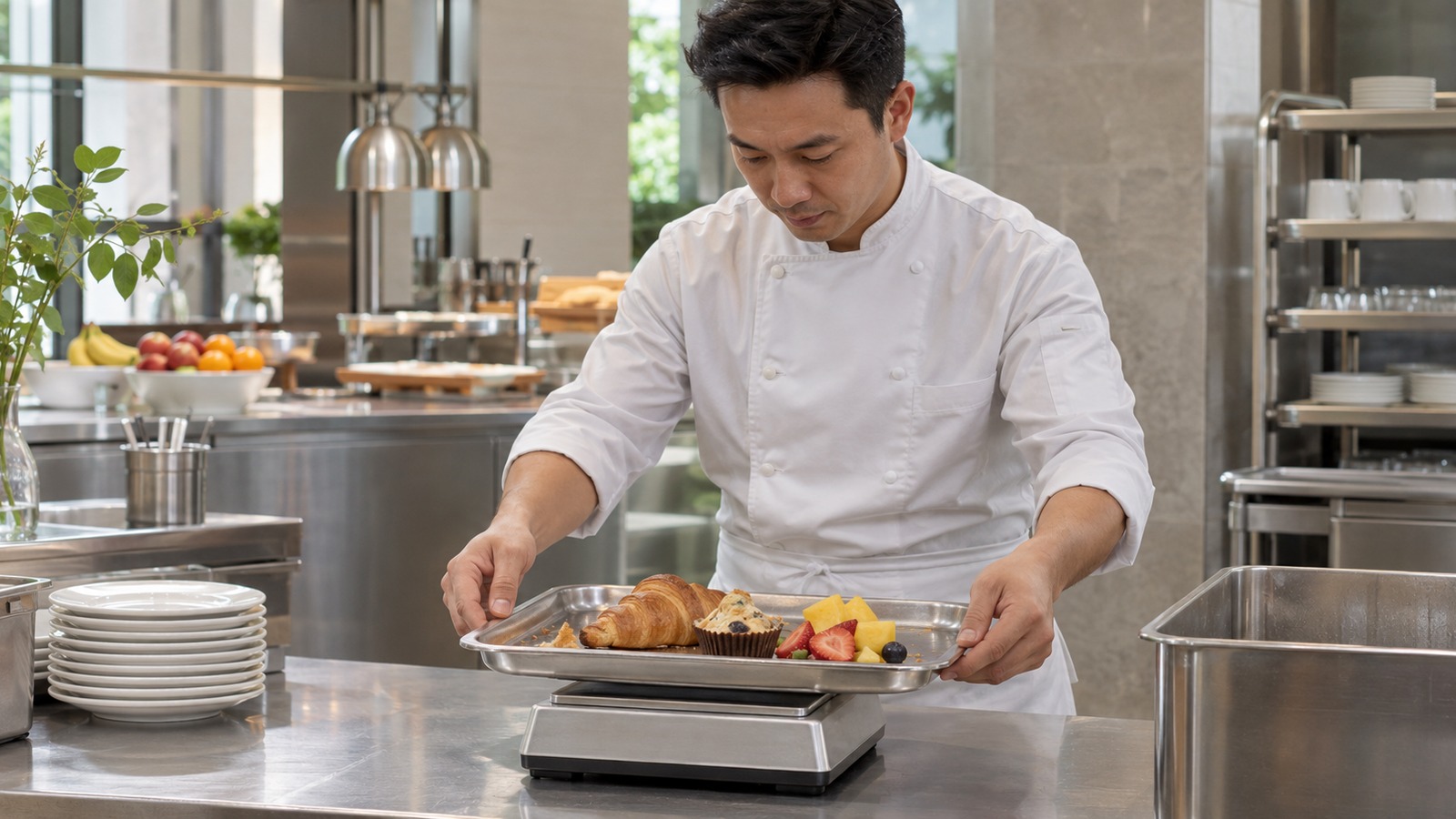
Winnow combines cameras, scales, and analysis to record kitchen food waste. Financial results depend on the team changing production, replenishment, or purchasing in response.
Potential benefit: Make recurring losses visible.
Limitations: Consistent measurement and active kitchen management remain necessary. Less waste does not automatically mean an equal reduction in purchasing.
Costs: The Winnow pricing model includes a configuration fee per system and an ongoing site subscription, quoted individually.
Evaluation: Compare avoidable waste and actual food cost per cover, accounting for menu, demand, and inventory changes.
Compare total costs with demonstrable value
Compare quotes for the same scope and period, such as three years. Depending on the solution, upfront costs include equipment, installation, integration, configuration, and training. Recurring costs include subscriptions, maintenance, consumables, support, and internal administration. Data export, contract commitments, and switching providers also belong in the decision.
On November 10, 2026, HiJiffy lists Basic from EUR 99 and Premium from EUR 319 monthly with annual payment; setup is EUR 99 and EUR 599 respectively per five properties. Pricing depends on room or bed count and scope. Confirm extras and tax treatment. We do not estimate unavailable total prices for other providers.
The following figures are hypothetical assumptions, not product prices or project results. If actual breakfast purchasing falls by CHF 600 per month at comparable demand, CHF 350 remains after CHF 250 in additional recurring costs. An initial CHF 2,100 outlay has a simple payback of six months. If purchasing falls by only CHF 300, the monthly benefit drops to CHF 50 and payback extends to 42 months. Do not count both waste value and the corresponding purchasing reduction as separate savings.
Time and cash also need to stay separate. Fifty freed staff hours at an assumed CHF 30 per hour represent CHF 1,500 of capacity. This becomes a cash saving only when expenditure such as paid overtime or temporary staffing actually falls. The simplified calculation excludes financing, taxes, residual values, and discounting.
Start with a clearly defined deployment
In the hypothetical 60-room hotel, one floor could trial an improved cleaning and room-release workflow if that is the largest documented bottleneck. The kitchen could establish a baseline through simple waste measurements. Building systems require their own assessment. Assign someone to evaluate each initiative and put the necessary changes into everyday practice.
- Establish a baseline: Measure volumes, active staff time, errors, quality, and actual expenditure.
- Assign responsibility: Identify owners for data, exceptions, devices, inspections, and release decisions.
- Limit the initial scope: Choose one workflow, team, or suitable building area, and test the fallback.
- Compare fairly: Include support and rework; account for occupancy, weather, or demand as appropriate.
- Make an explicit decision: Expand, adjust, or stop. Agree on success criteria before testing.
Oprivia focuses on operational gaps after booking: ownership, deadlines, evidence, review, and traceable completion. Whether an additional layer is useful depends on the existing operation. These products are not a list of promised integrations. A discussion of your use case can help identify the next practical step to investigate.
Sources and Notes
Editorial and professional context
Sources reviewed: November 10, 2026. Product capabilities and published prices come from the linked primary sources. They establish documented claims, not independent product testing. Workflow design, evaluation measures, and implementation advice are editorial recommendations. The hotel size and financial figures are hypothetical examples.
External professional sources
- Flexkeeping Automated Cleanings and Flexkeeping FAQ: cleaning schedules and pricing model.
- Kärcher Switzerland KIRA CV 50: product details and supplied equipment for version 1.454-500.0.
- RapidEye with Apaleo: photo analysis and room-status handling.
- HiJiffy Plans and Pricing: plan scope and published EUR starting prices on the review date.
- Vingcard Mobile Access and Upgrade Requirements: mobile access and model dependencies.
- Honeywell INNCOM Direct: system components and guestroom climate control.
- WINT FAQ: water analysis, alerts, and shutoff.
- Winnow FAQ and Winnow Pricing Model: food waste measurement and cost structure.
Oprivia sources
- Serviced Apartment Software: Choosing Your Stack: system responsibilities and integrations.
- AI in Hotels: Phone Automation and Guest Service: guest service, permissions, and handoffs.
- Oprivia Modules: operational scope and responsibilities.
Scope and limitations
This selection is neither a complete market survey nor a binding procurement recommendation. Capabilities, prices, and connections depend on the contract, system configuration, market, and property. No third-party connection mentioned here is promised as a tested or live Oprivia integration. Savings require a baseline and a suitable operational comparison. Photo analysis does not replace a full hygiene inspection or an accountable room-release decision. Qualified professionals must assess building installations and intervention rules for the specific property. Booking, distribution, and payment processing are covered in separate articles.