
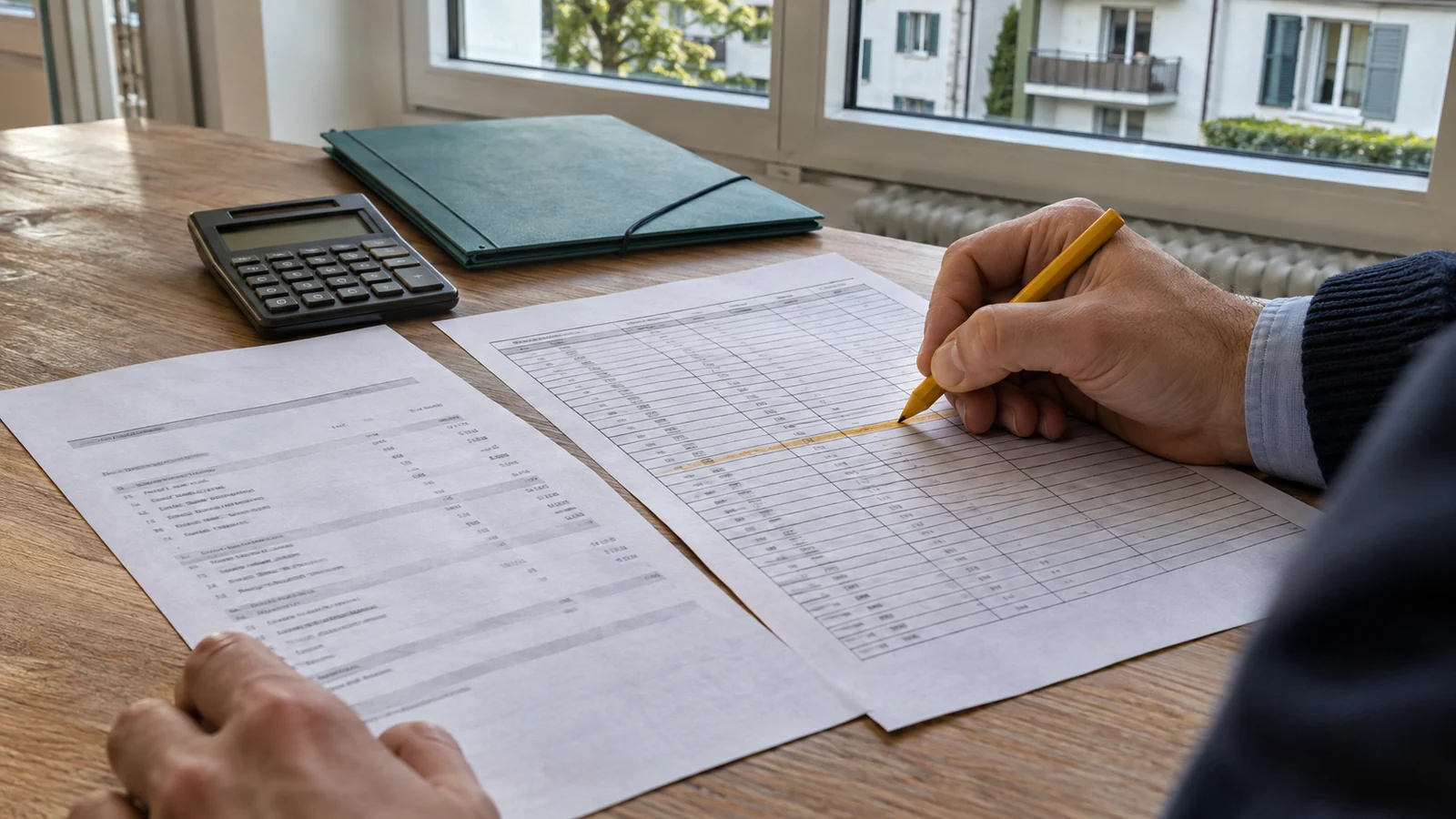
How nine confirmed turnovers can give rise to twelve charges
The work log lists nine apartment turnovers that have been checked. The contractor bills for ten cleans at CHF 120 each, a return trip at CHF 65 and a repeat clean at CHF 140. The invoice totals CHF 1,405 before any applicable VAT. Multiply nine departures by the agreed cleaning fee and you get CHF 1,080. The CHF 325 gap leaves the manager with three separate decisions. One of them is to approve a perfectly reasonable additional charge.
The apartments, rates and contract terms in this case are illustrative. You can follow the decisions in the accompanying workbook. Start with the original invoice, the rates in force when the work took place and the record of completed visits. Keep the contractor’s line numbers. When someone at the management company queries “line 11” two weeks from now, both offices need to be looking at the same charge.
Before matching individual visits, check the invoice itself. Does it name the entity that manages these apartments? Do the dates fall within the period being billed? Has an emailed copy of this invoice already been entered in accounts payable? A second invoice number is also worth a look when the property, dates and amount are identical. A change of operator can put the same job on the outgoing manager’s final statement and the incoming manager’s first one.
What the records establish for the first nine visits
For each of lines 1 through 9 the manager finds the original work order, the record of the clean and the supervisor’s completed check. The apartment and service date match. The contractor has charged the agreed flat fee of CHF 120. That gives the manager a basis to approve CHF 1,080. Keeping the work-order reference with each charge means a colleague can explain the decision later. There is no reason to invent a breakdown for travel, laundry or minutes worked on a job sold at a flat rate.
Similar apartment numbers and jobs straddling month-end cause particular trouble. Two visits to the same address may be legitimate if two separate stays ended. One visit may also appear under two dates because someone added a note to the work record the following morning. Match the service, apartment and date of the actual visit back to the individual job. A reservation number can narrow the search. It does not establish how many jobs the contractor carried out.
There is a useful example in GS1 Switzerland’s swissDIGIN invoice standard: the purchaser’s order reference lets the recipient trace a charge back to the order. A small property business need not implement that standard to borrow the idea. A legible job number beside the line description may be enough. If there is no common reference, record the documents that together establish the match so the next reviewer does not have to reconstruct it.
Line 10: a wasted morning at apartment 2.1
The cleaners arrive at 2.1. The key is still in the management office. The dispatcher acknowledges the mistake and asks them to return that afternoon. She has authority to order the additional trip. The contractor’s agreed rate for it is CHF 65. A service record shows the crew back at that apartment later that day. Two pieces of evidence settle the charge: the instruction to make a second trip and the record showing that it happened.
“You can pick up the key after noon” would leave a different question open. It tells the contractor when access will be available. Whether another trip is chargeable then depends on any existing agreement covering failed access or on a separate order. If the basis for the fee is missing, ask for that specific information. Requesting fresh photos of the clean apartment would cost the contractor time and leave the same question unanswered.
Here, the dispatcher’s instruction, her authority, the tariff and the service record all agree. The manager approves the additional CHF 65, bringing the total supported so far to CHF 1,145. For teams that encounter this regularly, the best place to settle it is at the time of dispatch. The Oprivia guide to vendor work orders explains where to specify who can authorize a second visit and what the contractor should do if the keys are missing.
Line 11: does the original fee cover a return visit?
At apartment 3.2, the inspector found used items among the clean linen set out for the next arrival. The contractor sent someone back and the inspector subsequently released the apartment. Everyone agrees the second visit happened. To assess the CHF 140 charge, the manager reads the scope agreed for the original turnover. It includes checking the linen and correcting mistakes of this kind within the original fee.
Give the crew credit for returning and record the separate billing decision. The CHF 140 needs a correction. The manager identifies the apartment, service reference and the relevant passage in the agreement, then requests a revised invoice or a credit note. “We don’t accept the repeat clean” would be an unfortunate way to put it. It sounds as though the management company doubts that the cleaner came back.
Consider what would change if an additional linen set for an extra bed had been ordered after the original job. The contractor might deliver it while correcting the linen error. Check the added item against its own order and price. The visit can contain both corrective work included in the flat fee and a separately agreed delivery. A brief note on who ordered the latter and what they asked for will do more to settle the bill than a long account of the entire visit.
Line 12: who cleaned apartment 1.4?
The guests left 1.4, the key changed hands and the next guest checked in that evening. The apartment plainly needed attention between stays. Those events do not identify the team that cleaned it. An in-house employee may have covered the turnover, the contractor may have filed the report under the wrong apartment, or this job may already have appeared on last month’s invoice. The same booking history is consistent with all three explanations.
Ask the contractor for the job reference and the work record made at the time of the clean. At the same time, the management team can check whether its own staff covered the unit that day. Assign one person to follow up and choose a review date that fits the accounts schedule. That gives the next shift a specific question to pursue and prevents one unresolved visit from disappearing when the rest of the bill is filed.
An original service record received late may still establish the visit. Someone’s recollection written down today should carry today’s date. Backdating a signature or attaching a photo of a tidy apartment will not restore an inspection that was never recorded. If the information meets the agreed requirements, approve the CHF 120. Until then, record the charge as “Pending.” That decision leaves the contractor a straightforward way to substantiate it.
Download the invoice reconciliation workbook (Excel)
How to use the reconciliation workbook
Open the “English” tab and save a working copy. Rows 9 through 20 contain the twelve invoice lines. Column C holds the amount, column D the decision and column E the supporting reference or next action. Row 5 summarizes the invoice. In the initial review, CHF 1,145 is “Approved,” CHF 140 is under “Correction requested” and CHF 120 is “Pending.” The three amounts add up to CHF 1,405.
To see the effect of one new piece of evidence, use apartment 1.4. In D20, change its decision from “Pending” to “Approved.” In E20, enter the reference and the date the missing record arrived. The amount approved rises to CHF 1,265, the amount awaiting correction stays at CHF 140 and the pending balance falls to zero. The invoice total remains CHF 1,405. Check E5, “Unassigned,” too. A balance there means some value sits outside the three recognized decisions. Even with a zero balance, look for empty or mistyped decisions, particularly on an invoice with both positive and negative lines.
The formulas cover twelve invoice lines. If you adapt the sheet for a longer invoice, extend both the calculation ranges and the decision dropdowns, then match the calculated total to the original bill. Operational approval records which charges the evidence supports. Accounts payable checks the due date, any agreed partial payments and the payment history separately before releasing funds.
What to tell the contractor before the payment run
A useful reply identifies the amount and asks for the one thing that would settle each outstanding line. Here is a message the manager could send once the initial review is complete:
“We’ve approved lines 1 through 10, totaling CHF 1,145. For line 11, please credit the CHF 140 or send a revised invoice removing that charge. The agreed turnover fee for apartment 3.2 includes this corrective work. For line 12, please send the job reference and the existing service record for apartment 1.4 (CHF 120). Please include the original invoice number in your reply.”
Accounts payable records the contractual due date and the planned follow-up separately. If the record for 1.4 arrives next month, update the decision against the original charge. If the same clean also appears on the next statement, flag both lines and resolve the duplication before approving the new invoice. An owner report can usually be shorter: identify the amount the owner is actually being asked to decide under the management agreement, the reason and the reference to the supporting documents.
There are two ways the contractor can correct the bill for 3.2. A revised invoice for CHF 1,265 can replace the original CHF 1,405 invoice. Alternatively, a credit note for CHF 140 can be applied to the original. Cross-reference the document numbers and use the correction once. After the visit to 1.4 has been supported, either route produces a net charge of CHF 1,265 before any applicable VAT. If accounts payable has already paid CHF 1,145, only CHF 120 remains to settle in this example. A colleague should be able to reach that number from the records without calling the person who held the keys.
Sources and Notes
Editorial and professional context
The apartments, orders, rates and contract terms are illustrative. The accompanying workbook reproduces the twelve charges and decisions so readers can check the arithmetic. Sources reviewed November 21, 2026.
External professional sources
- GS1 Switzerland, swissDIGIN invoice standard, purchase order reference K-01-05 (German). An example of how an electronic invoice can identify the purchaser’s original order.
- Swiss Federal Audit Office, report 25619, p. 23, section 5.2 (German). A public procurement review illustrates the connection between time-based invoices and the service records required under a particular contract.
Oprivia sources
- Work orders for vacation rental service partners. How to define a vendor’s scope and who can commission additional work.
- Operational owner reports for vacation rentals. How to explain a pending cost decision to the property owner.
Scope and limitations
All figures are before any applicable VAT. Whether a fee is due, when payment falls due and whether partial payments are appropriate depend on the agreement. The workbook records the manager’s operational review.