
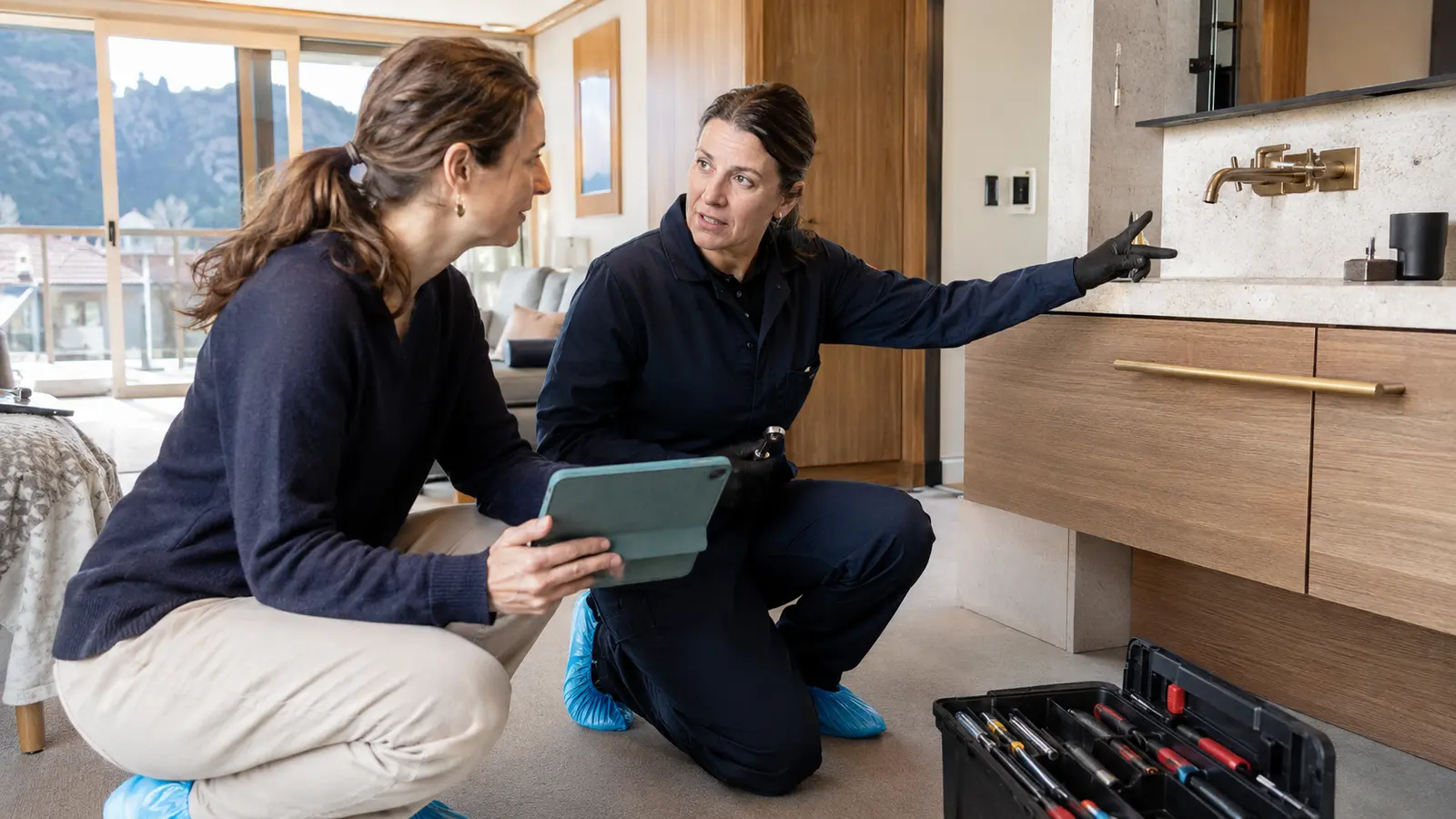
A guest reports water under the kitchen sink in the evening. The host messages the usual plumbing company, sends the address and door code, and promises an inspection the next morning. At 10 a.m., no one has arrived. The message was read, but the work order was never accepted. When a replacement technician arrives, she has not been told which connection is affected, what action she may take without checking back, or whether she may enter the occupied rental.
The main problem is not the repair itself. It is the assumption that sending a message creates an accepted and managed work order. Several decisions are missing between need and completion: Who accepts the work? What exactly is the expected result? What work may the technician perform, and up to what amount, without additional approval? How is entry coordinated with the guest? Who verifies the work and then informs the guest?
An owner with one vacation rental may bridge these gaps by phone for a while. As the portfolio, staff, and number of vendors grow, that approach becomes unreliable. A manageable vendor process therefore does not begin with the invoice. It begins with an unambiguous work order and ends only after the work is verified, follow-up items are closed, and access rights are revoked.
A request is not yet an accepted work order
A guest report and a vendor work order serve different purposes. The report records what the guest observes and how it affects the stay. The work order translates that information into an executable service. A sentence such as “Water under the kitchen sink, please inspect urgently” is rarely enough. It leaves open whether the authorization covers only diagnosis, a repair up to a stated amount, or a replacement.
Assignment alone also does not prove availability. A named person must be able to accept or decline the work order. If no answer arrives by the acceptance deadline, a defined backup path is needed. Otherwise, the office sees the work as assigned while no one in the field has taken responsibility.
For the guest, the original case remains open until the promised remedy has been verified and explained in clear terms. The technical task may be complete while a pricing decision, replacement service, or further observation remains outstanding. Conversely, a reply to the guest is not evidence that the repair happened. The guide to guest requests, tickets, and tasks explains this distinction between case ownership and execution in more detail.
Vendor selection and oversight should match the risk
A linen delivery to the front door, a turnover cleaning between stays, and electrical work in an occupied unit should not face the same review process. Potential harm, technical difficulty, access, urgency, and the consequences of failure determine the appropriate qualifications and oversight.
Before the first assignment, the operation should at least verify whether the vendor can provide the service in the relevant area and time window, who can be reached as the responsible contact, and whether backup capacity exists. Depending on the work, professional licenses, proof of insurance, safety instructions, or procedures for hazardous substances may also be required. If subcontractors may be used, the operator should also establish who will arrive and whether a personnel change requires renewed approval.
Under the conditions it specifies, the Swiss Ordinance on the Prevention of Accidents and Occupational Diseases requires coordination of safety measures when employees from multiple companies work at the same workplace. Suva identifies points including scope of work, contacts, hazards, permits, instructions, personal protective equipment, and supervision. These requirements do not apply to every small work order in the same depth. They do show why a customer should not silently leave known hazards and responsibilities to the external company.
A risk-based model remains intentionally lean. Standard instructions and spot checks are enough for recurring routine work. Work involving electricity, gas, water, locking systems, or occupied rooms calls for tighter limits, qualified personnel, and an explicit approval process. Oversight should prevent a specific harm, not create administration for its own sake.
A work order defines the result, limits, and decision authority
A useful work order answers the questions that would otherwise require phone calls from the job site. It may be brief, but it must be complete enough for a qualified person to act. A practical minimum structure includes:
- Context: accommodation, room, stay, or preparatory operational case.
- Starting point: factual observation, urgency, and known effects.
- Result: the expected functional or operationally ready condition.
- Scope: included service and interventions that are expressly not authorized.
- Time: acceptance deadline, service window, target deadline, and priority.
- Cost: authorized limit and the person responsible for approving an expansion.
- Access: permitted area, access credential, validity, and return or revocation.
- Evidence: required checklist, measurement, functional test, photo, or report.
- Closeout: reviewing role, release criterion, and escalation path.
The work order should make the expected result clear without prescribing an unsuitable method to a qualified technician. “Fix leak” is too open-ended if the affected area and whether only a diagnosis was commissioned are unclear. Conversely, operational coordination should not pretend it can determine the technical solution in advance.
Newly identified work is not added silently. The person performing the work reports the deviation, risk, and likely consequence. The role with approval authority decides whether to expand the scope, use an interim solution, or issue a separate work order. This keeps the originally agreed service and the person who approved added costs or interventions visible.
Occupied units require consent and data minimization in the workflow
A working key or code is a technical capability, not blanket permission to enter. For an entire place booked through Airbnb, Airbnb’s Protecting Your Privacy community policy generally requires guest permission before entry during a reservation, except in an emergency. The Expedia policy that applies to Vrbo bookings permits entry during a stay only for an active emergency or, with express advance consent, to resolve a time-sensitive issue. The contract and local law may impose additional or different requirements.
A planned visit should therefore identify the reason, proposed time window, expected duration, and person entering. Consent is linked to the specific stay and work order. If the guest does not respond, silence does not automatically become consent. The responsible role then decides the next step based on urgency, the contract, platform rules, and applicable law. Entry during an emergency is limited to what is necessary and documented factually afterward.
Data sharing remains limited as well. A plumber ordinarily needs the property, affected area, problem description, time window, and a suitable contact method. Copies of identification, complete booking histories, or private guest messages do not belong in the work order as a precaution. Under the Swiss Federal Act on Data Protection, personal data must be processed proportionately and for a defined purpose, among other requirements. Operationally, that means sharing only information needed for the job, limiting recipients, and not retaining data in private chats for convenience after its purpose has ended.
The article on roles and access rights in vacation rentals explains how physical and digital permissions fit together.
Completed, reviewed, and released are three different statements
The operation needs to distinguish acceptance, work in progress, reported completion, and review. Where a separate review is required, the authorized person records that decision separately. A completion report, invoice, or photo does not replace the review. Confirm which steps the software in use actually supports.
The evidence should fit the service. A delivery receipt may be enough for a delivery. A repair may require a problem description, the part used, a functional test, and a targeted completion photo. Cleaning follows its own standards, which the article on cleaning quality and operational release addresses in detail. More photos do not automatically create more confidence. Every item of evidence needs a purpose, a link to the property, a time, and a responsible reviewer.
If the result is incomplete, the work order is returned for rework with a reason. The new deadline and responsibility remain visible. A danger, lack of access, repeated failure, or substantial effect on the guest triggers the defined escalation path. After release, temporary codes and digital permissions are revoked and issued keys are returned where required. Only then is the work order operationally closed.
Escalation needs a decision, not just a red marker
Deadlines are useful only when the consequence of missing them is defined in advance. For an urgent defect, the operation may set an acceptance deadline, a time for the first update, and a target for the remedy. If a threshold is crossed, the case goes to a named role. That person decides whether a backup vendor takes over, an interim solution is sufficient, the unit must be temporarily blocked, or the guest needs other assistance.
An escalation proves neither acceptance by the replacement vendor nor resolution. It too needs an update, work order, and closeout. Deadlines must not quietly restart after reassignment. If the vendor is legitimately waiting for approval, material, or access, the reason for the pause is recorded. This makes it possible to distinguish deficient performance from an external blocker later.
When the backup vendor has not accepted
Continue the kitchen incident as a fictional example: by 10 a.m., the promised inspection has not happened. The host contacts a backup vendor. Until that vendor confirms, no one has accepted the work. The host records when an answer is needed, who will decide if the vendor declines, and when the guest will receive another update. Asking a replacement does not erase the original commitment.
To detect this case automatically, the condition is specific: the acceptance deadline has passed and no acceptance is recorded. An alert to the designated backup contact needs both pieces of information. Selecting a replacement vendor and obtaining acceptance remain separate steps.
The backup vendor later accepts and reports completion with a photo. The agreed record of the functional test is missing. The reviewer returns the submission with a specific reason: “Functional test not documented. Please add the result and time.” The reviewer records who must supply the missing evidence and by when. If the test already took place, its result and time are recorded as a later addition. Otherwise, a further check by a suitably qualified person is needed.
The record keeps the original commitment, backup acceptance, first submission, reason for return, added evidence, and final review decision distinct. The example on the solutions page shows how the deadlines work together. This additional failure scenario tests whether an unanswered assignment and incomplete evidence also lead to a clear next action.
Critical service types need realistic backup paths. A long contact list is not enough if no one has checked capacity, service area, and response time. A tiered network of preferred vendors, qualified alternatives, and specialized emergency contacts is more useful. Evaluation should consider acceptance time, blocked work orders, rework, incomplete evidence, and time to verified release. A simple case should not be compared with an overnight water leak.
Oprivia connects the work order, responsibility, and verified closeout
Oprivia connects tasks, responsibilities, and evidence after booking. Customer onboarding configures the access arrangements, assignments, review steps, and notifications for the agreed vendor workflow. The module overview describes the use cases.
For the connection between a vendor work order and the wider stay workflow, see the full guide to vacation rental operations after booking.
Oprivia does not select a contractor, assess the technical quality of a repair, or grant legal authority to enter. Cost approvals, safety decisions, and exception handling remain with the people designated for them. The features, notifications, and rules used depend on the current product version, agreed modules, and configuration.
A recurring, clearly bounded use case is enough to get started. For example, the operator can walk through a technical work order from the guest report to release. If the exercise establishes who accepts the work, which data is shared, how entry permission is obtained, what evidence is sufficient, who reviews it, and what happens after a failure, it achieves more than another vendor list. A message has become a manageable process.
Sources and Notes
Editorial and professional context
Sources reviewed: September 10, 2026. This article combines publicly available legal and platform sources with vendor-management standards and the public Oprivia product pages. Risk-based work-order categories, the proposed minimum structure, and the escalation logic are editorial operational recommendations. They are not generally applicable legal requirements.
External professional sources
- Ordinance on the Prevention of Accidents and Occupational Diseases, Article 9: the duty, under the stated statutory conditions, to coordinate necessary safety measures and exchange relevant information when several companies work together.
- Suva, Working with contractors: Have you ensured coordination?, 2019 edition: practical points concerning the work scope, contacts, hazards, permits, instruction, and supervision.
- ISO 37500:2014, Guidance on outsourcing: an international reference for the phases of outsourcing, governance, cooperation, and transitions. It does not set a particular procedure for vacation rental operations.
- ISO 9001:2015, Quality management systems: a quality-management framework that includes control of externally provided processes, products, and services. Citing it here is not a claim that Oprivia or an operator holds certification.
- Airbnb, Protecting your privacy: Airbnb's rule on obtaining a guest's permission before entering during a reservation, subject to the emergency exception.
- Expedia Group, Guest Privacy & Host Entry Policy: the rule relevant to Vrbo bookings for active emergencies and express advance consent when a time-sensitive issue requires entry.
- Swiss Federal Act on Data Protection: the Swiss statutory framework, including lawful, proportionate, purpose-specific, and secure handling of personal data.
Oprivia sources
- Oprivia, Modules: public overview of modules and operational workflows.
- Oprivia, Governance: roles, separation of duties, deadlines, escalation, and the continuous audit trail.
- Oprivia, Vacation Rental Access Rights: further material on physical and digital permissions.
- Oprivia, How to Control Cleaning Quality in Short-Term Rentals: a focused example involving cleaning standards, evidence, rework, and release for use.
Scope and limitations
Platform policies apply only within the relevant platform booking and may change. Entry, workplace safety, privacy, qualifications, payment, liability, and technical acceptance depend on the facts, contract, and governing law. Oprivia is not a PMS, locking system, contractor, insurer, or legal adviser. The available functions depend on the current release, module, contract, and configuration.