
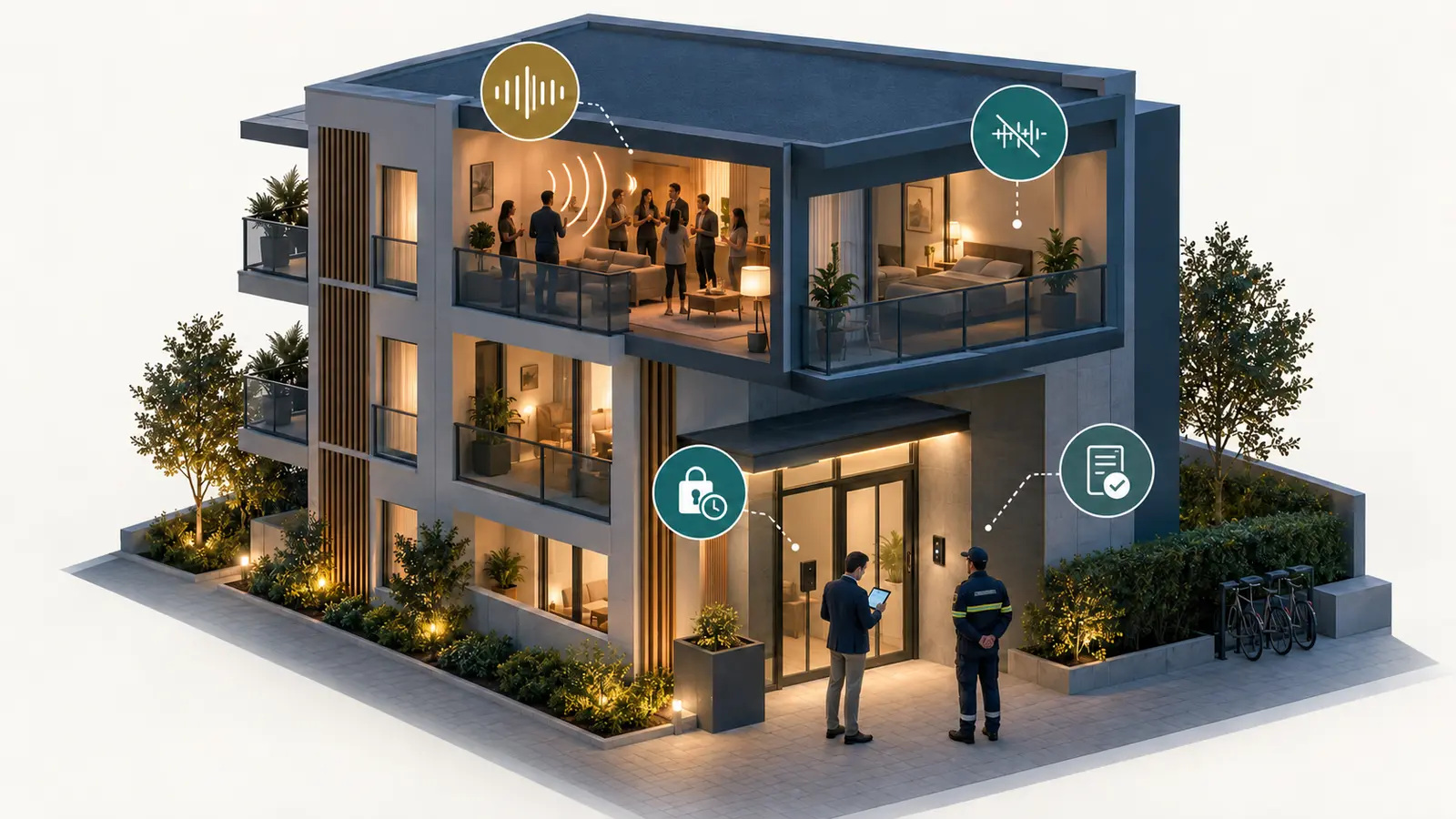
Late on a Friday evening, a neighbor reports loud music and several people in the hallway. The reservation lists four guests. The host is traveling, and the local contractor has a key but no clear instruction about what to do or how far their authority extends. An impulsive response can make the situation worse. Leaving the complaint unanswered is not a workable option either.
A professional operator first separates the facts. A noise report, a possible party, extra visitors, excess occupancy, and unauthorized entry are not interchangeable. They may occur together, but each calls for a different check. Calling every report a “party” invites false accusations. Treating every signal as a private matter can put neighbors, guests, and the property at risk.
House rules have to be clear before an incident
This work begins before check-in. House rules should state the overnight occupancy limit, whether visitors are allowed, the applicable quiet hours, and whether events are prohibited. They should also cover shared areas, parking, smoking, waste, and the contact for urgent concerns. These rules need to match the listing, the booking terms, local requirements, and the way the property is actually operated.
A broad instruction such as “do not disturb anyone” is hard to apply. A testable rule is more useful: no publicly advertised gathering, no extra overnight guest without a confirmed change, no use of shared areas outside building rules, and compliance with local quiet hours. Platform policies apply as well when a stay is booked through a marketplace. Airbnb’s current Community Disturbance Policy, for example, prohibits open-invite and disruptive gatherings and identifies excessive noise, trash, trespassing, smoking, parking problems, and neighborhood vandalism as possible signs of disturbance.
Rules only help if guests can review them before booking or, at the latest, before arrival. The operator should also decide who may approve an exception. A disclosed family visit during the afternoon is different from ten additional overnight occupants. That judgment belongs in the booking and house-rule process, not in an improvised argument at midnight.
A signal starts a review, not an automatic verdict
Information may come from a neighbor, a building manager, a service provider, an unusual number of people at the entrance, or a noise decibel monitor. Every source has limits. A neighbor may accurately describe the impact in the hallway while having no knowledge of the registered occupancy. A decibel reading shows a sound level and duration, but it does not identify the source or the people involved. Entrance footage may show movement without proving who intends to stay overnight.
The first record should separate observation from inference. “Music audible in the hallway since 11:20 p.m.; two reports from unit 3” is more useful than “illegal party with 20 people.” Record the time, property, reporting source, concrete impact, and any action already taken. Then compare the report with the reservation, house rules, and relevant local requirements.
Automatic sanctions based on a device alert alone are unreliable. A vacuum cleaner, an open window, or sound from outside the rental can trigger a threshold. Technology can shorten the time to awareness, but a responsible person still has to assess what the signal means.
Limit what monitoring devices collect
A property owner’s security interest does not erase guest privacy. Swiss operators processing personal data must consider transparency, purpose limitation, proportionality, and appropriate security under the Swiss Federal Act on Data Protection. Local laws, contracts, and platform rules may impose additional requirements.
Under Airbnb’s current policy on cameras and other devices, cameras and recording devices may not monitor any interior part of a home, even when switched off. Permitted exterior cameras must be disclosed and may not monitor indoor areas or private outdoor spaces. A noise decibel monitor may assess sound levels and duration, but it may not record audio. Its presence must be disclosed, and it may not be placed in a bedroom, bathroom, or sleeping area.
Switzerland’s Federal Data Protection and Information Commissioner also calls for a limited recording area, transparency, a small group of authorized viewers, and short, purpose-specific retention. The guidance notes that recorded scenes are not always unambiguous.
A device should collect only what is required for a defined purpose. Access to alerts and recordings must be limited to authorized people. Retention, deletion, and guest-information procedures should be settled before installation. Hidden indoor cameras, continuous audio recording, and the collection of private conversations are not acceptable shortcuts to party prevention.
The first decision concerns immediate danger
After a credible report, the on-call person needs a short decision path. The first question is whether anyone faces an immediate threat. Indications of violence, fire, a medical emergency, weapons, serious property damage, or people on a roof or balcony belong with local emergency services. Employees and contractors should not be sent alone into a dangerous situation.
If there is no immediate threat, contact the booking guest directly and stay factual. Name the observation, refer to the agreed rule, and request a specific action by a specific time. For example: “Please lower the volume now and confirm by 11:35 p.m. how many people are currently in the apartment.” Accusations, personal threats, and long legal explanations usually make de-escalation harder.
If the guest does not respond or the disturbance continues, follow the prepared escalation path. That may involve a second contact level, the responsible manager, platform support, an authorized local representative, or the appropriate public authority. The right step depends on the danger, contract, building rules, location, and time of day. A booking platform is never a substitute for police, fire, or medical services.
A visitor, excess occupancy, and unauthorized use are different cases
An evening visitor is not automatically an additional overnight guest. A unit is not necessarily over capacity because more people are briefly present in the living room than appear on the reservation. The operator must examine the agreed use, confirmed guest count, visitor rules, lawful occupancy limit, and available facts.
Unauthorized use can take several forms. The booking guest may be absent and have handed the property to others. Additional people may stay overnight. A former guest may use a code that was never disabled. Someone may enter a room or building area without permission. In each case, the operator needs to establish who has a valid right to stay or enter and who may approve a change.
The PMS or booking channel remains the system of record for the reservation and confirmed guest count. Oprivia does not change a booking or grant a right of occupancy. If another guest must be registered or the reservation amended, the authorized person completes that step in the appropriate system. Oprivia’s article on digital guest identity explains why identity checks, statutory registration, and access approval remain separate decisions.
Do not revoke access without checking the consequences
A compromised code or lost key may need to be disabled quickly. Before making that change, confirm the current occupants, valid access rights, emergency entry method, responsible decision-maker, and likely consequences. A lawful guest should not be locked out without a safe alternative. The replacement credential should go only to people with a confirmed need.
A contractor should not receive a vague instruction to “remove those people.” Their task may be to verify a visible condition, change a lock, or complete a technical step approved by the responsible person. Physical intervention, rights of entry, and eviction require a contractual and legal basis and, in a conflict, the involvement of competent professionals or authorities.
The Oprivia guide to roles and access rights examines how identity, purpose, property, time window, and revocation should be handled together.
Neighbors need one reachable and discreet contact
A vacation rental operation loses local trust when neighbors cannot reach anyone or have to repeat the same report to several people. Each location should have a clear contact route. The first response acknowledges the report, asks for the place, time, and concrete impact, and gives a time for the next update. It should not promise a penalty or disclose personal guest information.
After the intervention, a short reply is enough: the report was reviewed, the responsible person acted, and the same contact should be used if the disturbance returns. A neighbor generally does not need guest names, booking details, or information about financial consequences. Repeated reports involving the same property should still be linked internally so that recurring causes become visible.
Airbnb also provides Neighborhood Support for community complaints. Its Community Disturbance Policy tells users to contact local emergency services when an emergency is in progress.
Keep the incident file concise and reviewable
A late-night case can quickly produce screenshots, call notes, message threads, and device alerts. More material is not necessarily better evidence. A workable incident file includes:
- property, unit, stay, and booking guest,
- the house rule or obligation that may be affected,
- each concrete report with its time, source, and impact,
- any device signal, including the device, measurement, and known limitation,
- contact attempts, replies, and deadlines given,
- each escalation and its responsible person,
- changes to a key or code,
- damage, special cleaning, or impact on the next arrival,
- a reasoned closure and any follow-up task.
Keep the original records. Add later corrections to the history instead of silently replacing the first note. Label inferences as inferences. Oprivia’s guide to vacation rental audit trails explains how source, version, correction, and review fit together.
The next morning is part of the response
The case may not be finished when the music stops. The next shift checks access, the condition of the unit, waste, shared areas, and readiness for the next guest. Property damage is handled separately from the safety incident. A platform report, contract question, or special cleaning task may also remain open.
The review should look beyond blame. Were the house rules vague? Did an old code remain active? Was no qualified person available overnight? Did a late booking change make the guest count inaccurate? Operators can only recognize patterns if incidents are classified consistently. Useful measures include confirmed disturbances per 100 stays, time to first guest contact, the share resolved within the stated deadline, external interventions, and repeated incidents by property. Raw incident totals without stay volume produce misleading comparisons.
Oprivia can organize the case, but it is not a security service
The guide “Vacation Rental Operations After Booking: A Practical Guide” shows how this process connects with the other work attached to a stay.
Oprivia is designed for operational work after a confirmed booking. Within the released and agreed scope, a report may be connected with the stay, property, responsible role, deadline, evidence, follow-up task, and closure. Available intake channels, alerts, and automations depend on the release, module, contract, and configuration.
The platform does not monitor a property, determine that a law was broken, remove a person, replace a security provider, or automatically alert public authorities unless a specific capability has been technically verified and expressly agreed. The operator remains responsible for the decision. A sound process makes sure that the decision is timely, uses limited data, and can be understood by the next shift.
Sources and Notes
Editorial and professional basis
Sources reviewed: September 11, 2026. This article distinguishes a noise report, a disruptive gathering, additional visitors, excess occupancy, and unauthorized use. The proposed response times, escalation levels, incident file, and metrics are editorial operating recommendations. They must be adapted to the location, building, contract, platform, and actual risk.
External primary sources
- Airbnb: Community Disturbance Policy, current platform policy covering open-invite and disruptive gatherings, noise, trash, trespassing, parking, enforcement, and Neighborhood Support.
- Airbnb: Restrictions on security cameras and other devices in homes, current rules for interior cameras, exterior cameras, recording devices, noise decibel monitors, and disclosure.
- Swiss Federal Act on Data Protection, the Swiss framework for transparent, purpose-specific, proportionate, and secure processing of personal data.
- FDPIC: Video Surveillance by Private Individuals, guidance on recording area, justification, proportionality, transparency, retention, access, and incident-only review.
Oprivia sources and related guides
- Oprivia Platform, public description of operational work after booking.
- Oprivia Governance, roles, limited permissions, evidence, review, and escalation.
- Vacation rental roles and access rights, guidance on person, role, purpose, property, and time window.
- Digital guest identity, separating identity, registration, approval, and access.
- Vacation rental audit trails, source, version, correction, and review of operational evidence.
Scope
This article provides general operational guidance, not security, legal, or privacy advice. It does not replace a local risk assessment, building rules, police instructions, or review of entry and occupancy rights. Platform rules and local requirements may change. Oprivia does not monitor a property, remove a person, or replace emergency services, a security provider, or a public authority. Product capabilities depend on the release, module, contract, and configuration.