

A listing can be taken offline in minutes. The way an apartment is used may remain exactly the same. That distinction now matters in Switzerland’s short-term rental debate: where guests book does not establish whether a property may legally operate in that form.
Zurich began applying a new minimum residential floor-area rule in September 2026. A national STR survey, explicitly described as non-representative, has also been published. Both deserve closer attention. The study records operators’ experiences and self-assessments. The legal status of a particular Zurich apartment depends on the applicable rules and their application to that property. A market survey cannot settle that question.
What the STR study tells us, and what it does not
The Swiss STR Study 2026 from HES-SO Valais-Wallis received 234 online survey responses. The research is explicitly non-representative.
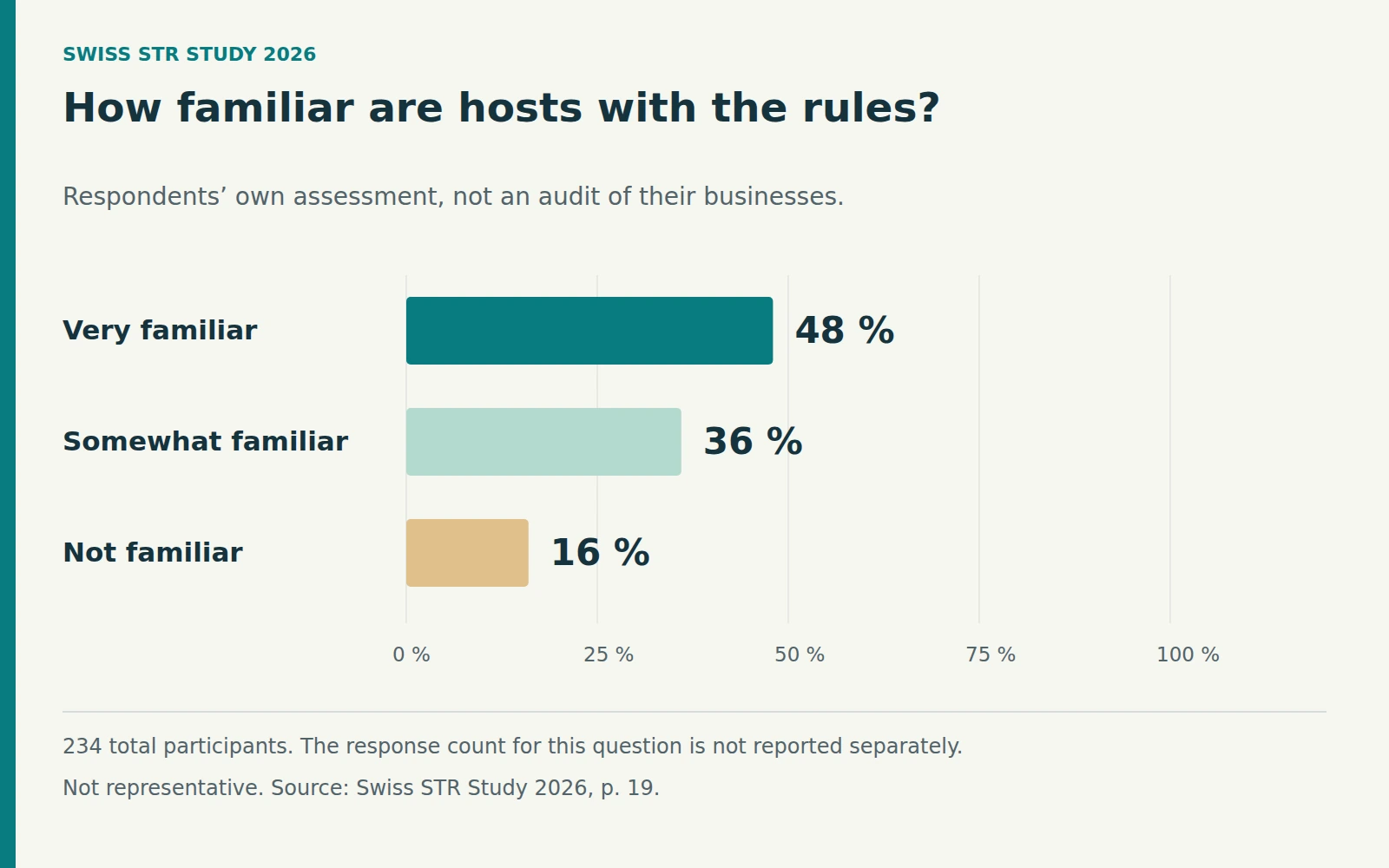
On page 19, concerning knowledge of the rules, 48% report being very familiar, 36% partly familiar and 16% unfamiliar. These self-reported answers are not audited compliance findings.
These self-assessments show neither how often rules are broken nor whether the participating businesses meet all applicable requirements. That would require examining the specific obligations and records for each property. The sample does not establish how widespread such uncertainty is across the Swiss market.
Adriano Brander participated in the survey as an accommodation operator. He was not a member of the author team. The analysis below combines the published findings with official information and experience from operating accommodation and speaking with other providers.
Three questions that are easily confused
“We are registered” can mean several things. Registration for guest reporting addresses a different question from a building or change-of-use permit. A completed tourist-tax return documents another obligation. Treating these records as interchangeable can confuse an orderly administrative process with permission to operate the underlying business model.
A useful property review therefore separates three questions. What uses are permitted at this location? What use has been approved for this particular unit? And what obligations follow from the way the accommodation actually operates? The answers need to fit together before they can support a sound business decision.
There is a financial reason to make the distinction early. Spending on furnishing, direct distribution or further automation should rest on a clarified operating model. Otherwise, the business may improve processes while the legal basis for its use of the property remains unresolved. Our comparison of short-term rentals in Switzerland and neighboring countries provides further context on national and local differences.
What changed in Zurich in September 2026
The City of Zurich gives September 1, 2026 as the effective date of the partial amendment to its building and zoning ordinance concerning uses that no longer count toward the required residential share. The Federal Supreme Court had dismissed the challenge in judgment 1C_401/2024 of April 30, 2026. The rule concerns the minimum proportion of specified qualifying floor area that must serve residential use.
It addresses regular commercial letting of an entire apartment or parts of it for fixed terms of less than one year, together with the residence-related conditions specified in the rule. Where the statutory conditions for exclusion are met, the entire apartment does not count toward the residential share, even if only part is offered for short-term letting. The ordinance takes account of actual principal-residence use and the specified equivalent uses under Article 2(3)(a), (c) and (g) of the Second Homes Act. Merely registering someone with the population office does not always establish a principal residence. The Federal Supreme Court explains this distinction in its judgment.
“Airbnb is banned in Zurich” is therefore not a useful operating instruction. The relevant questions concern the floor area and its use, rather than the booking platform’s logo. Nor does a “commercial” or “residential” zoning label provide a complete answer on its own. The applicable rules, required residential share and property-specific approval must be considered together.
According to the city’s announcement of the rule taking effect, occasional letting of one’s own home during an absence is exempt. That does not create a general exception for every furnished apartment or extended stay. Letting an apartment for several months is not automatically outside the rule simply because it is marketed as a long stay.
How to examine a particular Zurich property
Start with the map, then examine the approvals
The city’s cadastral information service for the building and zoning ordinance is a sensible starting point. An address or parcel reference provides access to planning information. Supplementary plans and special provisions also need attention. A color on the zoning map, however, is not an individual operating permit for an apartment.
The next step is to connect those rules to the approved premises. Ask the owner or property manager for the relevant building decisions, approved plans and subsequent changes of use. Authorized applicants can obtain missing documents from the Building Permits Office archive. Third parties must demonstrate their entitlement, usually through an appropriate authorization from the owner. A public listing cannot substitute for these records.
The residential share is not a count of apartments
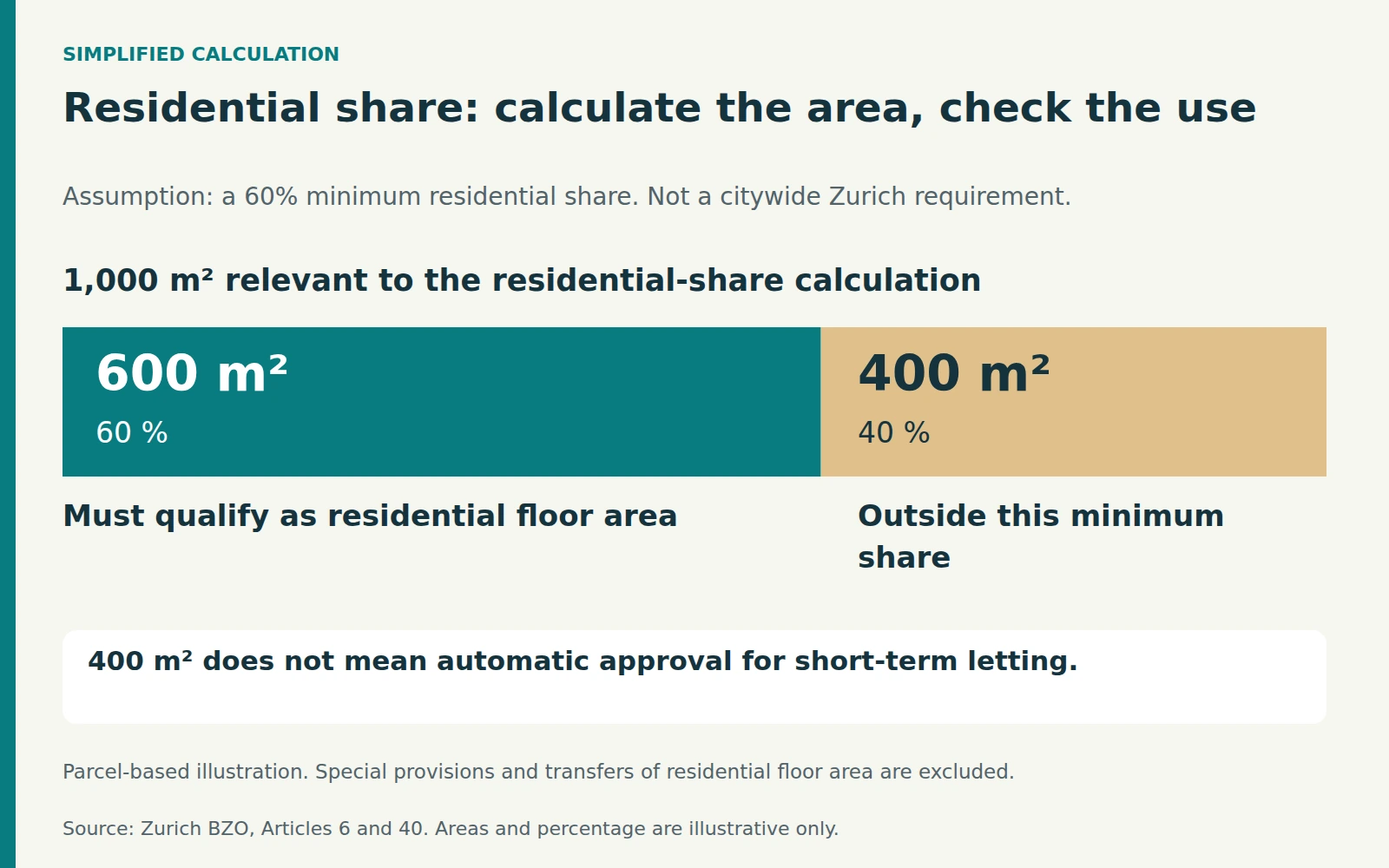
Consider a simplified calculation: a parcel has 1,000 square meters of relevant qualifying floor area and a confirmed minimum residential share of 60%. At least 600 square meters must then remain available for qualifying residential use. That does not automatically mean six out of ten apartments must be rented conventionally while four can become short-term rentals. Unit sizes may differ. This example expressly excludes special provisions and permitted transfers of the required residential share. Additional rules can apply to particular floors or areas.
The remaining 400 square meters are not blanket permission for business apartments either. The approved or approvable use of that area requires separate examination. This example illustrates the floor-area calculation only. It is not an assessment of an existing property.
Describe the actual operating model
The documents should be accompanied by a factual description of the business. Useful details include the units concerned, usual rental arrangements, fixed terms, residence circumstances and existing approvals. What matters is the use that actually takes place or is proposed. A label such as “temporary living” cannot replace that information.
The city expressly states that changes of use may require an application even without building work. Its current guidance says an application must be submitted for letting of less than one year where the prescribed residential share is not maintained. The appropriate procedure for a particular property should be clarified with the Building Permits Office. The Canton of Zurich identifies the municipality where the property is located as the first point of contact for permit questions.
An application initiates a review. Submitting it does not make an impermissible use lawful or guarantee approval. Oral guidance should also be recorded together with the facts presented. Where a question determines whether the business can operate, establish what formal decision is needed. General advice by email and a building permit serve different purposes.
Enforcement changes the value of old assumptions
Zurich has approved five additional full-time positions for three years to support enforcement. Its September 1 announcement said these resources were expected to become available during the fourth quarter of 2026. Tages-Anzeiger’s reporting on enforcement illustrates the level of public attention. It does not prove that all positions have already been filled or that every reported address is non-compliant.
Existing businesses need particular care. On its guidance page, the city takes a restrictive position on protection for existing uses, referring to apartments that can return to ordinary residential letting without building work. Whether a specific previous use benefits from protection should therefore be examined professionally against the approvals and investments concerned. Years of letting alone are not reliable evidence that the business may continue unchanged.
What operators describe in personal conversations
Adriano Brander has heard very different responses in his own conversations with operators. Some intend to continue letting and react only if a fine becomes a prospect. Others say they have removed their Airbnb listings while continuing to rent through other channels. These accounts are paraphrased here. They are neither a systematic survey nor a representative picture of the industry.
They also do not establish that any particular operator is acting unlawfully. For Zurich’s residential-share rule, however, taking a listing offline does not by itself change planning status or actual use. Direct bookings can change distribution. They do not resolve an outstanding question about permissible use.
The conversations are useful mainly as an indication of different risk assessments. They help explain why announcing a rule does not produce a uniform response. One operator may need an understandable explanation, another needs to locate historic approvals. A third already has the records but has not assigned anyone to follow unresolved questions through to a usable answer.
What may change next, and what already applies
Switzerland does not have one uniform municipal short-term rental rule. Lucerne provides a useful comparison. Since January 2025, certain accommodation created from residential premises has been subject to a limit of 90 nights per year. The city’s March 2026 implementation report also explains exemptions, transitional cases and uses approved without that limit. A number without its scope is of little help to an operator.
Zurich’s separate popular initiative to protect housing and regulate Airbnb and business apartments must be distinguished from this. It is not another name for the residential-share rule that took effect in September. The city executive has announced a counterproposal to be submitted to the municipal parliament by January 4, 2027. Discussion of additional restrictions should therefore be described as an ongoing political process, not as an already effective general 90-day cap.
One operational implication is reasonable: a business with several locations needs a traceable update for each property. The question is not only which rule has changed. It is also which operation is affected, which records are missing and who will follow the inquiry through to a usable result. Whether further restrictions will be adopted remains open.
Where Oprivia can contribute
Oprivia’s approach starts with organizing that work. A property needs a traceable review status: the sources used, decisions already available, unresolved questions, responsible people and the next agreed action. When an operator changes or another location is added, the information should not have to be reconstructed from scattered messages.
This provides a working basis for coordination with owners, property managers, specialists and authorities. The support and technical functions appropriate to a business should be agreed around its actual operational gap. A platform cannot issue a building permit or replace a property-specific legal assessment.
If the position is unclear today, start with one actual apartment and its records. That can establish a reliable way forward. A general verdict on “Airbnb in Switzerland” cannot.
Sources and Notes
Editorial and professional context
Sources reviewed October 8, 2026. The legal discussion reflects that review date. Study findings, official rules, qualitative operator accounts and editorial recommendations are distinguished. Participation in the survey is the author’s own statement and does not imply authorship or an institutional partnership.
External professional sources
- City of Zurich: Binding zoning ordinance, Articles 6 and 40 August 2026 version, including the residential-share provision effective September 1, 2026.
- Swiss STR Study 2026 Peter, Baumgartner, Stuber-Berries and Fux, September 2026. Methodology p. 2, self-reported regulatory findings pp. 19–20. Not a representative market statistic.
- HES-SO announcement of the STR study Original September 19, 2026 announcement with a link to the complete report.
- City of Zurich: Short-term rentals Current guidance on the residential share, implementation and the city’s position on protection for existing uses.
- City of Zurich: Entry into force on September 1, 2026 Effective date, permit questions and staffing resources approved for enforcement.
- Federal Supreme Court: Judgment 1C_401/2024 of April 30, 2026 Full judgment via Entscheidsuche. Articles 6/40 in the facts, consideration 7.2.1 on residence registration, consideration 8.3 on existing uses.
- City of Zurich: Building and zoning ordinance Zoning and supplementary plans, cadastral information and the separately described ongoing revision.
- City of Zurich: Building-project archive Obtaining building decisions and plans, with conditions for access.
- Canton of Zurich: Building permits The property’s municipality as the first point of contact and general permit requirements for relevant changes of use.
- City of Zurich: Separate popular initiative and counterproposal An ongoing political process, separate from the residential-share rule already in force.
- City of Lucerne: Implementation report, March 30, 2026 A dated implementation account explaining scope, exemptions and transitional cases.
- Tages-Anzeiger: Zurich enforcement report, September 1, 2026 Journalistic context. Subscription article.
- Tages-Anzeiger: Zurich rule explained, June 26, 2026 Additional journalistic perspective. Legal explanations rely on the official sources linked above.
- Tages-Anzeiger: Industry association and STR study, September 19, 2026 Further reporting on the industry debate. The study discussion here uses the original report.
Oprivia sources
- Short-Term Rentals in 2026: Switzerland and Its Neighbors The broader practical comparison.
- Guest Registration in Switzerland Distinguishing and organizing recurring duties.
- Audit Trails and Operational Evidence Traceable records and review status.
Scope and limitations
This is not legal advice or a permit assessment for a specific property. The floor-area example is expressly hypothetical and simplified, and grants no permission. Study percentages describe self-reported answers from a non-representative sample, not proven infringements. The report states 234 participations overall but does not give a separate valid-response count for the individual questions used here. Operator accounts come from personal conversations and are paraphrased. Product capabilities, integrations and official approvals are not assumed to be in place.