
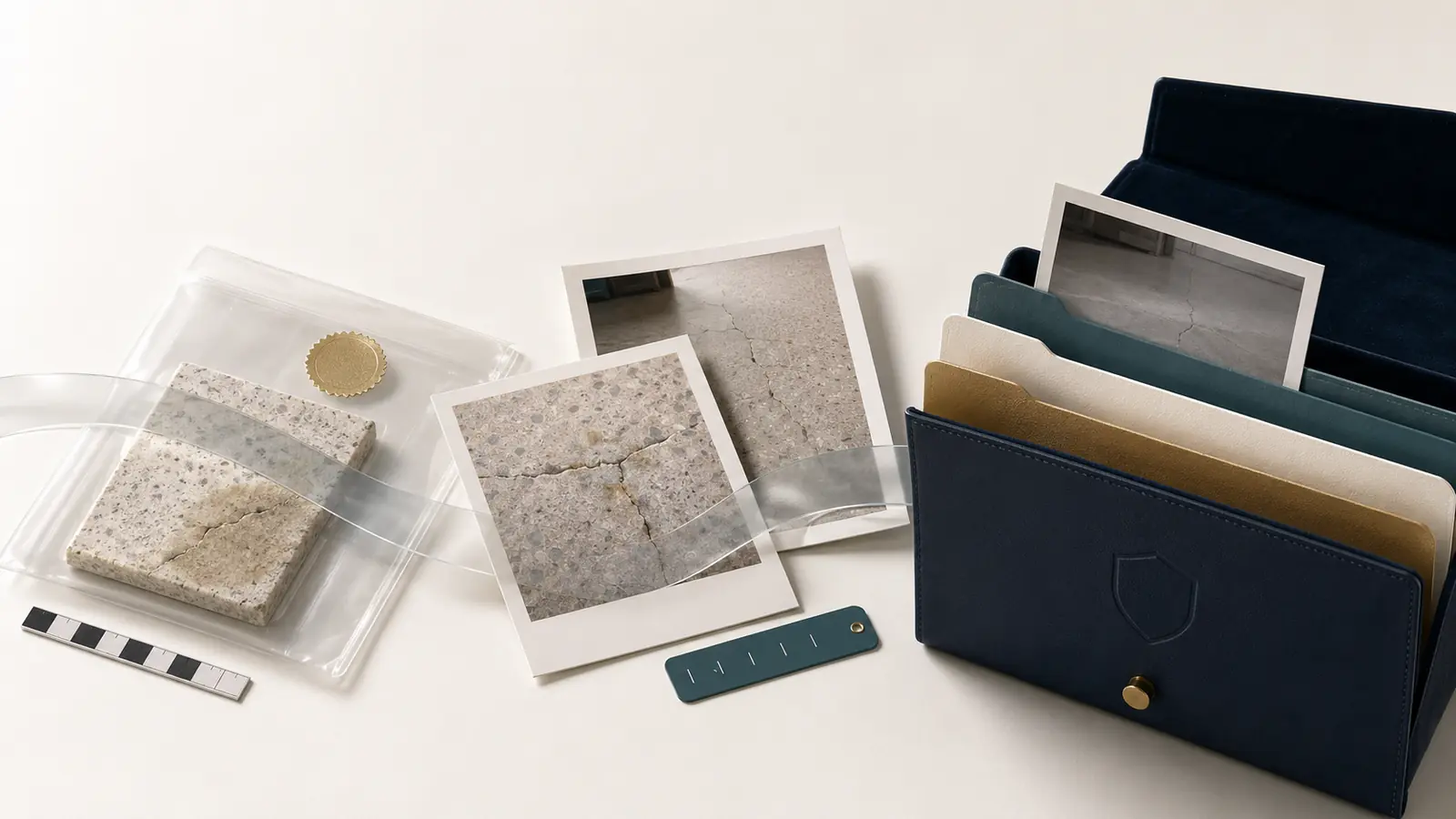
A Damage Case Is Not a Single Event but a Chain of Evidence
A guest reports a water leak. During turnover, a deep scratch is discovered in the parquet. A television no longer works. Or a visitor falls on a poorly lit staircase.
In day-to-day operations, all four situations are quickly described as “damage”. Legally, technically and from an insurance perspective, however, they represent different types of case. The relevant questions include:
- What was actually damaged?
- Did the defect already exist?
- Is the condition normal wear and tear, a technical defect or damage beyond ordinary use?
- Who had custody or control of the accommodation during the relevant period?
- Is there a connection between the guest’s conduct and the damage?
- Who may be liable to the owner, the guest or a third party?
- Which insurance policy or platform programme may be relevant?
- Which deadlines and evidence requirements apply?
- Which immediate measure will prevent the damage from becoming worse?
A photograph taken after check-out rarely answers these questions on its own. Without a documented initial condition, a reliable timeline, an account of the incident, proof of ownership and traceable costs, the operator is often left with little more than the assertion that the damage must have occurred during the most recent stay.
Professional damage management therefore does not begin with the claim notification. It begins before the first guest arrives.
First Distinguish Wear and Tear, Damage, Defects and Liability Claims
Not every visible change is compensable guest damage. Five categories support the initial assessment.
Normal Wear and Tear
Minor signs of use arise even where accommodation is treated carefully: light marks behind furniture, age-related deterioration of surfaces or ordinary wear to flooring.
Under Swiss tenancy principles, normal contractual wear and tear is generally compensated through the rent. It cannot simply be treated as new damage chargeable to a guest or tenant. The distinction between normal and excessive wear, including the effect of depreciation, is explained by the Swiss Tenants’ Association.
Damage Beyond Normal Wear and Tear
A burn mark, a broken window, a deep impact mark in a washbasin or water damage caused by improper use may go beyond normal wear and tear.
Even then, the compensable amount does not automatically equal the price of a new item. Age, previous condition, customary useful life, repair options and any remaining value must be considered. Damage to a ten-year-old interior does not retrospectively turn it into a new interior.
Technical Defect or Inadequate Maintenance
If an old appliance stops working without an external cause, it is not automatically guest damage. The same applies where water escapes from a worn pipe or an already loose component finally breaks.
Equating cause and responsibility prematurely may produce an unjustified claim against the guest while also delaying notification to the insurer, owner or maintenance party that may actually be responsible.
Liability Claim Involving Guests or Third Parties
If a guest is injured because of an alleged defect in the accommodation, or an incident damages a neighbour’s property, the case no longer concerns only the operator’s own building or inventory.
Bodily injury or damage to third-party property becomes central. In addition to the technical cause, the operator must examine safety obligations, maintenance, warnings, responsibilities and the legally sufficient causal connection.
Business Interruption and Consequential Costs
If an accommodation unit becomes temporarily unusable following an insured property-damage event, confirmed bookings, relocations, additional cleaning, emergency work and income may be affected.
Business-interruption or loss-of-income insurance does not automatically pay for every cancelled night. The interruption will commonly need to result from an event covered by the policy. The insured trigger, waiting period, indemnity period and calculation method must correspond to the operator’s actual letting model.
Who May Be Liable in Switzerland?
Where the Host Is the Tenant
A person who provides rented accommodation to paying guests generally operates within the area of subletting. Under Article 262 of the Swiss Code of Obligations, the landlord’s consent is required. Consent may in particular be refused where the conditions are not disclosed, are abusive or cause substantial disadvantages to the landlord.
The principal tenant remains responsible to the owner for the contractually compliant use of the property. The Federal Council’s report on regulation in the accommodation sector explains that the principal tenant must answer for the conduct of the subtenant. Stating that “the guest caused it” does not remove the principal tenant’s responsibility towards the landlord.
The principal tenant may in turn assess a claim against the guest. Whether and to what extent that claim is enforceable depends on the contract, the incident, fault, the proven value and the available evidence.
Consent to sublet and insurance coverage are separate questions. The owner’s permission does not replace an insurance policy. Conversely, insurance does not make an unauthorised subletting arrangement lawful.
Where the Host Is the Owner
Owners must distinguish between damage to their own building, damage to their own inventory and claims made by third parties.
Where a guest suffers loss because of defective construction, faulty design or inadequate maintenance of a building or other structure, the owner’s liability under Article 58 of the Swiss Code of Obligations may become relevant. A fall does not automatically establish liability. A defect, loss and a legally sufficient causal connection between them remain necessary.
For accommodation operated directly by the owner or managed professionally, business liability may also be relevant—for example in relation to acts by employees, inadequate instructions, deficient maintenance or organisational failures.
Where Several Parties Are Involved
In practice, several relationships may exist simultaneously:
- owner and principal tenant;
- host and guest;
- operator and cleaning partner;
- owner and property manager;
- operator and maintenance provider;
- injured party and liability insurer;
- host and booking platform.
The person who first discovers the damage is not automatically the person who caused it. The party arranging a contractor is not necessarily the party that must ultimately bear the cost.
A damage file must therefore keep facts, decisions and payments separate.
A Party Making a Claim Must Generally Be Able to Prove It
Under Article 8 of the Swiss Civil Code, a party deriving rights from an alleged fact must generally prove that fact.
A claim for compensation will typically require several elements:
- specific and identifiable loss;
- the condition before and after the event;
- a breach of duty or another legal basis for liability;
- attribution to a responsible person;
- a legally sufficient causal connection;
- the amount claimed.
A timestamp proves when a file was created or stored. It does not automatically prove who caused the damage. A photograph shows a condition, but not necessarily its cause. An invoice shows costs, but does not automatically demonstrate that the entire amount is legally recoverable.
Evidence becomes robust through the interaction of several sources of information.
The Initial Condition Is More Important Than the Later Damage Photograph
Before an accommodation unit begins operating, it should have a documented baseline. This should include:
- overview photographs of every room from defined perspectives;
- detailed photographs of sensitive or valuable surfaces;
- an inventory identifying the item, manufacturer and model;
- purchase date or estimated age;
- invoices, warranties and available serial numbers;
- existing damage or signs of use;
- ownership information for rented or entrusted inventory;
- date and responsible person completing the record.
The baseline must be updated whenever furniture is replaced, rooms are renovated or technical equipment is exchanged. A three-year-old photograph is not a reliable comparison where the furnishing has since changed.
Turnover documentation from cleaning and partner management also has a second function. It does not merely demonstrate guest readiness; it may help narrow down the period in which a change of condition occurred.
What a Verifiable Damage File Should Contain
1. Unambiguous Assignment
Every case requires at least:
- property and affected unit;
- booking or stay;
- check-in and check-out;
- time of discovery;
- reporting person;
- affected room and item.
For a portfolio, a filename such as IMG_4837.jpg is insufficient. Without assignment data, the image cannot later be matched reliably to the correct stay or insurance notification.
2. Overview and Detail
Effective photographic documentation combines:
- an overview of the room;
- the location of the affected item;
- a close-up of the damage;
- a size comparison where required;
- additional images from different angles.
Photographs should be taken as soon as possible after discovery and before the condition is changed. Original files should be preserved unaltered. Filters, retrospective removal of objects or AI-generated additions undermine credibility.
The current Airbnb Host Damage Protection Terms expressly require legitimate and verifiable evidence. Altered or artificially falsified material may result in rejection.
3. A Factual Account of the Incident
The description should separate observation from assumption.
Imprecise:
“The guest destroyed the parquet.”
Better:
“During the inspection on August 2, 2026, at 11:20 a.m., two parallel scratches measuring approximately 42 and 47 centimetres were identified in front of the bed. They are not visible in the completion photographs taken before check-in on July 30. The technical cause has not yet been assessed.”
The second version records facts without presenting unresolved responsibility as established.
4. Value and Costs
Depending on the case, the following may be required:
- original invoice;
- age and previous condition;
- warranty documents;
- repair report;
- cost estimate;
- replacement offer;
- invoice for completed work;
- calculation of current or remaining value;
- additional cleaning costs;
- demonstrable downtime.
A claim must not be calculated solely by reference to the current price of a new item. For used property and rental damage, the remaining value is relevant. If a repair is feasible and economically reasonable, complete replacement may be disproportionate.
5. Communication
Messages exchanged with the guest, owner, partner and insurer form part of the file. Relevant elements include:
- initial notification;
- questions and responses;
- acknowledgement or denial of the facts;
- instructions for mitigating loss;
- approval of repairs;
- claims and decisions;
- applicable deadlines.
Cases connected to a platform should also be communicated through the platform. A telephone conversation conducted elsewhere can subsequently be confirmed through a factual written summary.
Insurance Protection Is Not a Single Product
The expression “insurance for a holiday apartment” is too imprecise. Depending on the operating model, several layers of cover may be necessary.
Building Insurance
Building insurance concerns the structure and insured building components. Which fire, natural-hazard, water or supplementary risks are covered in Switzerland also depends on the canton and any complementary private policies.
Building insurance does not automatically answer the liability question where a guest is injured and does not necessarily protect movable inventory.
Household, Contents or Business-Inventory Insurance
This layer concerns furniture, appliances, textiles and other movable property. Operators should determine:
- Is the particular unit recorded as an insured location?
- Does the insured sum correspond to the current inventory?
- Is paid short-term letting expressly included?
- Is guest damage covered, or only conventional risks such as fire, water and burglary?
- Is settlement based on replacement value, current value or specific sublimits?
- Are art, cash, keys and electronic equipment restricted?
Private household insurance is not automatically business-inventory insurance.
Personal, Building or Business Liability Insurance
Liability insurance assesses whether the insured is legally liable, defends against unjustified claims and pays justified insured claims within the policy terms.
The required form of insurance does not depend solely on the number of apartments. Relevant factors may include:
- ownership or tenancy;
- private or commercial activity;
- frequency of letting;
- annual turnover;
- services provided;
- employees and auxiliary persons;
- management of third-party properties;
- types of guests;
- territorial scope.
Business liability generally protects against particular third-party claims. It does not normally replace the operator’s own inventory or compensate the operator’s own loss of income. The AXA business-liability overview, for example, distinguishes third-party bodily injury and property damage from the company’s own property damage, defective performance and pure financial loss.
A “business-insurance package” is commonly modular. Its name does not guarantee that every risk arising from accommodation operations is included.
Business Interruption or Loss of Income
This cover may become relevant where an insured property-damage event makes the accommodation unusable. Operators should examine:
- insured triggering events;
- basis used to calculate income;
- seasonal variations;
- confirmed and expected bookings;
- waiting period;
- maximum indemnity period;
- additional costs for alternative accommodation;
- dependency on individual locations.
For multiple apartments, it must also be determined whether an incident is covered only for the individual property or under a shared sum insured.
Legal Expenses and Cyber Risks
Disputes concerning liability, owner claims, guest claims or insurance benefits are not automatically covered by liability insurance.
Operators processing digital access information, identity data, guest communications or payment information also have cyber and data-protection risks. These do not arise from the damaged piece of furniture itself, but they may result from the same incident—for example following loss of an access system or unauthorised disclosure of guest information.
When Is Private Insurance No Longer Sufficient?
There is no universal number in Switzerland. The boundary results from the respective policy.
For example, Helvetia’s guidance on holiday-property insurance states that its described private-liability solution no longer provides cover for a property containing more than three apartments and that building-liability insurance is then required.
AXA’s personal-liability product information states that damage arising from self-employed activity is covered under that product only up to annual turnover of CHF 20,000. This too is a product-specific condition, not a general threshold for short-term accommodation.
These examples demonstrate why assertions such as “I am privately insured up to three apartments” or “business liability covers everything” are unsafe.
Before the first stay, the insurer should confirm in writing:
- which addresses and accommodation units are insured;
- that paid short-term letting or accommodation activity has been disclosed;
- whether owned and third-party properties are operated;
- which booking channels are used;
- whether guest, inventory, building and third-party losses are covered;
- whether employees, cleaning partners and property managers are included;
- which deductibles, sublimits and exclusions apply;
- whether loss of income and relocation costs are covered;
- which notification deadlines and cooperation duties apply;
- which changes must be reported without delay.
A telephone statement that the arrangement “should be fine” is not reliable confirmation of insurance coverage for a portfolio.
Platform Protection Is an Additional Layer, Not Comprehensive Insurance
Airbnb: Separate the Damage Programme from Liability Insurance
Airbnb distinguishes between Host Damage Protection and Host Liability Insurance.
Under the Host Damage Protection Terms, Host Damage Protection is not insurance. Subject to its terms, it guarantees the primary payment obligation of a responsible guest in relation to qualifying losses.
The nominal limit of USD 3 million says little about an individual claim on its own. Relevant factors include:
- qualifying accommodation and booking;
- qualifying property and loss;
- direct causation by a guest or invitee;
- applicable exclusions;
- current or repair value;
- complete and verifiable evidence;
- compliance with procedural deadlines.
Under the terms updated on August 1, 2026, the host must, within 14 days of check-out, use reasonable efforts to claim the amount from the responsible guest and notify Airbnb. The Host Damage Protection payment-request form and supporting evidence must be submitted within 30 days of check-out.
Airbnb may request photographs, videos, receipts, ownership evidence, acquisition date, condition at the time of loss, repair estimates and, in specified cases, a police report.
The separate Host Liability Insurance Programme concerns certain liability claims arising from bodily injury or third-party property damage. It does not insure the host’s own accommodation or inventory.
For portfolios, another point is important. Since March 1, 2025, the programme terms permit Airbnb, where a host has at least six active listings, to require contribution from other applicable insurance or to treat the platform cover as excess insurance depending on the wording of the other policy. Failure to disclose applicable insurance may affect coverage.
Booking.com: Liability Cover Is Not Cover for the Partner’s Own Property
The Booking.com Partner Liability Insurance Policy Summary for 2026 includes Switzerland and may cover specified liability claims made by guests or other third parties in connection with qualifying stays booked through Booking.com.
The policy expressly excludes loss of or damage to the partner’s own property, accommodation or property in the partner’s custody. A television damaged by a guest and a neighbour’s liability claim following water damage are therefore separate coverage questions.
The current policy runs from January 1 to December 31, 2026. Its continuation or unchanged structure in later years must not be assumed.
The Multi-Channel Problem
Platform programmes generally apply only to stays booked through the respective platform. Direct bookings, bookings through another platform, periods outside the defined rental period or excluded accommodation categories may fall outside the programme.
The more an operator sells through Airbnb, Booking.com, direct bookings, corporate contracts and other channels, the less the operator’s underlying protection should depend on a single platform.
The International Comparison Shows the Same Fundamental Risk
Legal systems and insurance products differ, but the recurring pattern is similar.
The US National Association of Insurance Commissioners warns that ordinary residential building and household policies are frequently not designed for incidents arising from short-term rentals. Paying guests or an activity classified as a business may be restricted or excluded.
The Insurance Bureau of Canada recommends disclosing a changed use before letting begins and retaining written confirmation. An undisclosed letting arrangement may materially change the insured risk profile.
The lesson is not that the same exclusions apply everywhere. It is that private residential use and recurring accommodation operations are not the same insurance risk.
A Robust Damage-Handling Process
1. Protect People and Mitigate the Loss
People take priority over evidence. Stop the water supply, isolate electricity in affected areas, obtain medical assistance or block access to the accommodation.
Necessary emergency measures should be documented. They should not, however, remove the cause of the loss unnecessarily before it can be examined.
2. Reassess Guest Readiness
A safety-related defect must not be treated solely as a repair task. The operator must decide whether the unit may remain occupied, must be blocked internally or requires relocation of the guest.
3. Classify the Incident Provisionally
The operator should distinguish between:
- normal wear and tear;
- suspected guest damage;
- technical defect;
- maintenance deficiency;
- theft or unexplained absence;
- bodily injury or third-party damage;
- potential insured event;
- combination of several causes.
The classification remains provisional until cause and responsibility have been examined sufficiently.
4. Secure the Evidence
Photographs, original files, messages, appliance statuses, legally permissible access information, statements from involved persons and available supporting documents must be assigned to the correct stay.
For theft, vandalism or potentially criminal conduct, the operator must assess whether the police need to be involved without delay.
5. Inform the Appropriate Parties
Depending on the case, the relevant parties may include:
- guest;
- owner or property administration;
- insurer;
- booking platform;
- maintenance provider;
- cleaning partner;
- facility or building service;
- police or emergency services.
Notification should be timely without making an unexamined admission of liability.
6. Control the Deadlines
Every case requires visible deadlines for:
- platform notification;
- insurance notification;
- requests for additional documents;
- the guest’s response;
- contractor appointments;
- restoration;
- decisions concerning upcoming bookings.
A deadline held in a private note is not a controlled deadline for a team.
7. Coordinate the Repair
Major definitive repairs should not be commissioned unilaterally where the owner or insurer must approve them. Immediate safety and loss-mitigation measures remain an exception.
Defective or damaged items should not be discarded before approval where retaining them is safe and reasonable. Allianz Suisse’s claims guidance likewise recommends preserving damaged items until the evidential situation has been clarified.
8. Calculate the Claim Transparently
The calculation should distinguish between:
- repair costs;
- replacement value after considering age;
- additional cleaning;
- necessary emergency measures;
- demonstrable loss of income;
- deductibles;
- payments already received.
Unsupported replacement prices or punitive lump sums weaken a claim.
9. Close the Case Under Controlled Conditions
A case should not be closed until it is established:
- how the damage was remedied;
- which party bears which amount;
- which payment has been received;
- which bookings were affected;
- whether a recurrence risk remains;
- which preventive measure has been agreed.
Data Protection: Preserving Evidence Without Unnecessary Surveillance
Damage photographs may contain personal data—for example faces, identity documents, luggage tags, medication, documents or private messages.
Under the Swiss data-protection principles explained by the FDPIC, processing must be purpose-bound, transparent and proportionate. In practice:
- take condition and damage photographs after check-out where possible;
- avoid unnecessarily photographing guests or workers;
- do not photograph identity documents or private papers;
- remove access codes and key numbers from the image area;
- restrict access to damage files;
- store original evidence securely;
- define retention periods according to purpose and potential claim duration;
- delete data under controlled procedures once the purpose has expired.
Continuous or concealed monitoring inside accommodation is not an appropriate replacement for a proper condition inspection.
Multiple Apartments Change the Risk
Individual Host
For one accommodation unit, a current inventory, defined turnover photographs, a clear notification route and written confirmation of insurance coverage may often be sufficient.
The main risk is usually not missing software but an unclear baseline and dependency on one person.
Principal Tenant Subletting the Property
Owner claims, guest claims and the principal tenant’s own insurance coverage interact. The owner’s consent, principal lease, subletting conditions and insurance policy must be compatible.
Damage to building components is particularly sensitive because the principal tenant may remain responsible to the landlord before successfully recovering any amount from the guest.
Business and Serviced Apartments
Business and serviced apartments commonly involve longer stays, intermediate cleaning, corporate bookings and repeated access by service providers.
This makes attribution over time more difficult. Damage may have arisen while the guest, cleaning provider, maintenance company or internal team had access. Handover and intermediate inspections therefore require greater structure.
Portfolio Operators
With multiple units, both the number of incidents and concentration or accumulation risks increase:
- several units in the same building;
- shared water pipes or technical installations;
- loss of a central key or access system;
- the same cleaning partner;
- shared sums insured;
- several bookings becoming unavailable simultaneously;
- different owners and contractual models.
Insurance review must therefore be property-specific, role-specific and channel-specific. A policy suitable for the first owner-operated apartment is not automatically sufficient for ten third-party apartments under management.
When Insurance Protection Should Be Reviewed Again
A renewed written assessment is advisable in particular when:
- the first short-term letting begins;
- another apartment or location is added;
- the operation changes from owned to rented property;
- third-party properties are brought under management;
- a contractual turnover or property threshold is exceeded;
- the operating entity is created or changed;
- new booking channels or direct bookings are introduced;
- employees are hired;
- new services such as breakfast, transport or wellness are added;
- a pool, sauna, charging station or digital access system is installed;
- the inventory value increases materially;
- similar incidents recur;
- policy conditions change.
Indicators That Make Damage Management Controllable
Detection time: Time between check-out and documented discovery.
Notification time: Time between discovery and notification of the responsible party.
Evidence completeness: Percentage of cases containing a baseline, damage images, description and proof of value.
Deadline compliance: Percentage of platform and insurance notifications submitted within the relevant deadline.
Restoration time: Time required to restore safe usability.
Damage cost per 100 stays: More comparable than an unadjusted number of incidents.
Recovery rate: Percentage of claimed costs that was actually reimbursed.
Reasons for rejection: No cover, insufficient evidence, missed deadline or non-compensable wear and tear.
Recurrence rate: Repeated occurrence of the same cause at a property, with a partner or involving a particular appliance.
A low reported-damage rate is not automatically positive. It may also indicate that damage is not being detected or reported.
How Oprivia Is Intended to Support This Control Logic
Oprivia is conceived to manage damage as a property- and stay-specific operational case rather than an isolated chat message.
A case can be connected with a responsible role, priority, deadline, status, description and supporting evidence. This keeps visible:
- who identified the damage;
- which stay is affected;
- which immediate measure was taken;
- which documents remain outstanding;
- which party has been informed;
- when a platform or insurance deadline expires;
- who approves the repair;
- whether the accommodation is guest-ready again.
Role-based access limits the visibility of sensitive guest, damage and contractual data. A traceable history records which decision was made, when and by whom.
Oprivia thereby complements PMS and booking systems with operational handling after the booking. Further information on this control layer is available under Governance and in the overview of the Oprivia modules.
Oprivia does not determine legal liability or insurance coverage. Its function is to make the operational handling, documentation, responsibilities and deadlines traceable. Available functions must be checked against the actual release scope.
In Brief
Does Personal Liability Insurance Cover Letting Through Airbnb?
There is no general answer. The declared use, letting frequency, turnover, number of properties and individual policy conditions are decisive. Short-term letting should be disclosed to the insurer in advance and confirmed in writing.
Is AirCover Sufficient as Insurance?
No. Airbnb’s Host Damage Protection is not insurance under its own terms. The separate Host Liability Insurance Programme addresses different risks. Both depend on Airbnb stays, eligibility requirements, exclusions and reporting procedures.
Which Photographs Are Required for Guest Damage?
An overview of the room, the location of the item, several detailed images and, where helpful, a size comparison. Comparative images showing the condition before the stay, a factual description and proof of value are also required.
Must the Guest Always Pay the Replacement Price?
No. Repair options, age, remaining value, customary useful life and previous condition must be considered. Damage does not automatically create an entitlement to an entirely new replacement.
When Does an Operator Need Business Liability Insurance?
A business solution should be assessed when the activity can no longer be placed reliably within confirmed private coverage. There is no universal threshold. Business liability alone also does not normally cover the operator’s own inventory, building or loss of income.
May a Repair Be Commissioned Immediately?
Necessary safety and loss-mitigation measures must be taken without delay. Before major definitive repairs, the operator should clarify with the owner and insurer who may issue the order and which evidence must be preserved.
Conclusion: A Risk Becomes Insurable Only Once It Is Described Correctly
A damage case cannot be controlled simply by collecting as many photographs as possible. What matters is the connection between the documented initial condition, timeline, factual description, proof of value, clear responsibility and timely handling.
As the number of apartments grows, private assumptions and platform-specific individual solutions become increasingly inadequate. Operators must know which risks are carried by their own insurance, which are addressed only by a platform and which remain entirely with the business.
The best time for that assessment is not after the first major loss. It is before the first check-in—and again whenever the portfolio changes materially.
Information status: August 1, 2026. This article provides general information and does not replace a legal assessment, insurance review or confirmation of coverage for a particular operation or incident.
Sources and Notes
Editorial and Legal Context
This article provides a general overview of the Swiss legal and insurance framework as at August 1, 2026. It does not constitute legal advice, insurance advice or confirmation of coverage. Whether a particular loss is insured depends exclusively on the individual policy, the applicable general and special insurance conditions, the declared business activity and the circumstances of the incident.
Product and platform information is used as a specific example and must not be transferred to other insurers, tariffs, countries or later insurance periods. The international comparison identifies recurring risk patterns, not identical legal rules.
Swiss Legal Foundations and Specialist Sources
- Swiss Code of Obligations, in particular Articles 58, 101, 257e, 262 and 267 CO — Liability of property owners, liability for auxiliary persons, rental security, subletting and the condition in which rented property must be returned.
- Federal Council: Regulation in the Accommodation Sector — Official report dated November 15, 2017 concerning recurring short-term letting, the responsibilities of principal tenants, wear and tear, guest claims and platform services. Official German PDF.
- Swiss Civil Code, in particular Article 8 CC — General rule governing the burden of proof: a party deriving rights from an alleged fact must prove that fact. Official German text.
- Federal Act on Insurance Contracts — Statutory framework governing notification of insured events, information and supporting evidence, mitigation of loss and liability insurance. Official German text.
- Swiss Tenants’ Association: Which Damage Must Tenants Pay For? — Distinction between normal wear and compensable damage, consideration of depreciation and the importance of precise handover records. Official German PDF.
- Helvetia: Insurance for Holiday Homes and Apartments — Overview of building, contents and liability coverage. The stated threshold of more than three apartments concerns the private-liability solution described by Helvetia and is not a general statutory limit. Official German page.
- AXA: Personal Liability Insurance — Product-specific information concerning liability arising from self-employed activity up to the stated annual-turnover threshold. The threshold is not a general rule for short-term accommodation. Official German page.
- AXA: Business Liability Insurance — Distinction between insured third-party claims and the company’s own property damage, defective performance and pure financial loss. Official German page.
- Allianz Suisse: How to Report an Insurance Claim Correctly — Guidance on documenting damage, preserving damaged property and avoiding premature compensation payments. Official German page.
- Federal Data Protection and Information Commissioner: Data-Protection Principles in Rental Contexts — Purpose limitation, transparency and proportionality when processing personal data. Official German guidance.
Platform Terms
- Airbnb: Host Damage Protection Terms — Contractual damage-protection guarantee, expressly not an insurance policy; current reporting, evidence, valuation and exclusion rules. Last updated August 1, 2026.
- Airbnb: Host Liability Insurance Program Summary — Liability insurance for certain third-party bodily-injury and property-damage claims. The terms concerning hosts with six or more active listings have applied since March 1, 2025. Last updated June 30, 2026.
- Booking.com: Partner Liability Insurance Policy Summary 2026 — Liability coverage for qualifying third-party claims at eligible properties, including in Switzerland. The policy excludes loss of or damage to the partner’s own property and runs from January 1 to December 31, 2026.
International Comparison
- National Association of Insurance Commissioners: Renting Out Your Home? You Need Insurance Coverage for Home-Sharing Rentals — Explains why ordinary residential building and household policies may not be designed for short-term rental activity.
- Insurance Bureau of Canada: Renting Out a Room? What You Need to Know About Insurance — Explains how letting changes the insured risk profile, why the insurer should be informed and when landlord or business coverage may be required.
Editorial Scope
The legal and insurance statements in this article are based on the legislation, official guidance, insurer information and platform terms cited above. Product-specific limits and platform deadlines are stated solely in the context of the respective published terms.
Oprivia does not determine liability, calculate compensation, assess insurance coverage or decide platform claims. Product-related statements are limited to the operational assignment, documentation, deadline management and traceability of damage cases. The availability of individual functions depends on the actual development and release status.
