
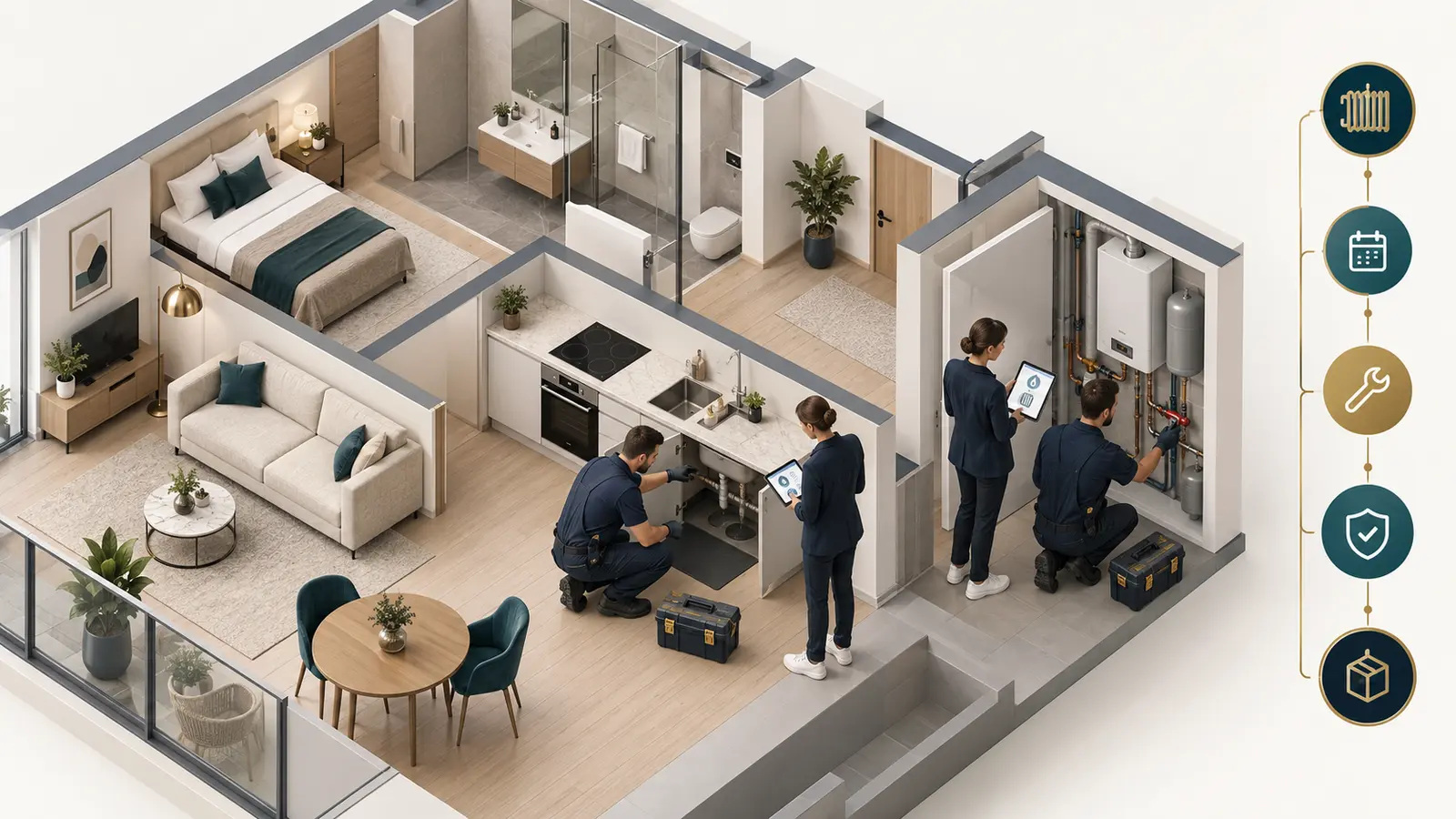
On Friday evening, a guest reports water under the kitchen sink. The cleaner had noticed moisture that morning but only posted a photo in the team chat. The usual maintenance technician knows the property but cannot be reached. A plumbing company could send a technician, but it needs authorized access and approval for the service-call charge. The operator also has to decide whether the unit remains habitable and whether the apartment below may be at risk.
The defect itself is technical, but the response usually fails elsewhere: the observation is never recorded as a case; no one sets the urgency; two people hire different contractors; or a temporary measure is treated as a completed repair. These gaps become more common across a portfolio because each person sees only part of the situation.
A sound maintenance process connects the immediate incident with the longer history. During the incident, the operator must limit harm and disruption. Afterward, the team checks whether the same component or appliance has failed before. This allows recurring faults to be addressed instead of treating every repair as an isolated ticket.
Classify the risk before assigning the repair
Not every technical fault is an emergency. A flickering bedside lamp, a failed refrigerator, and the smell of smoke still cannot sit in the same queue. Before discussing cost or ownership, the operator needs a quick assessment of possible danger, impact on habitability, and risk to other units.
Three plain categories are usually enough for internal use. Emergency means that people or the building may be in danger. The local emergency plan and instructions from the competent authorities apply. In Switzerland, the official ch.ch emergency page lists 117 for police, 118 for fire, 144 for ambulance, and 112 as the European emergency number. An app is not a substitute for an emergency call. Urgent covers faults without an apparent immediate danger that materially disrupt the stay or may soon cause further damage. Planned covers work that can reasonably wait for an agreed appointment.
These are operating definitions, not a legal conclusion. The person in charge still has to consider local rules, manufacturer instructions, insurance terms, and the facts on site. The business should also specify who may take a unit out of service, relocate a guest, or approve an immediate protective measure.
The first report must contain a usable finding
A photo labeled “Please check” rarely gives the next person enough information. The first report should identify the property and unit, time, observed symptom, affected area, impact on the guest, apparent danger, and any action already taken. For a water leak, that may include whether the supply has been shut off, whether electrical equipment might be affected, and whether water has reached another unit.
Keep observation separate from diagnosis. “Water is emerging below the sink” is a finding. “Burst pipe” is already a technical conclusion. A premature diagnosis may send the wrong contractor and later make an unproven cause look established. Photographs should show the affected area without unnecessarily capturing people, documents, or personal belongings.
When the report concerns an occupied stay, one person must own the overall case. The article “Guest Requests: From Message to Verified Resolution” covers that path in detail. Technical maintenance adds one more question: Which asset or component is involved, and has it produced a similar fault before?
A modest asset register prevents blind decisions
An operator with twenty apartments does not necessarily need a large facility management platform. A maintained record of critical assets still gives the team a common reference. For each property or unit, record at least the component or appliance, location, manufacturer and model, commissioning date, warranty, known constraints, responsible specialist, and available manuals. Add any inspections and intervals required locally for safety-related equipment.
The international standard ISO 41001:2018 sets requirements for a facility management system intended to support organizational objectives and the needs of interested parties. A vacation rental operator does not need ISO 41001 certification to learn from that approach. The useful principle is simple: maintenance is a managed service with requirements, responsibility, and review, not a loose collection of contractor visits.
The asset record supports a maintenance schedule. Intervals should come from manufacturer instructions, legal requirements, insurance conditions, warranties, and operating experience, not from a generic template. Each item needs an owner, a realistic service window, an access plan, and a completion criterion. A calendar reminder with no accountable person is not a maintenance process.
Do not let repeat failures look like new incidents
A water heater that fails three times in six weeks has not produced three unrelated tickets. The events need to be connected. A stable asset reference, a plain fault category, date and operating condition, work performed, parts used, and the result of the functional check make comparison possible. The record can then show whether one cause appears to be recurring or whether different problems merely look alike.
When a pattern emerges, a named decision maker should determine whether another repair is reasonable, a specialist assessment is required, or replacement should be prepared. That person needs the earlier findings and costs but should not treat every contractor statement as conclusive. A quote, an invoice, and a functional test answer different questions.
A connected history also discourages premature claims about liability. Under Article 58 of the Swiss Code of Obligations, the owner of a building or other structure may be liable for damage caused by defects in construction or design or by inadequate maintenance. Whether the requirements are met demands a legal assessment of the specific case. Maintenance records do not automatically disprove liability. They can, however, help establish what was known and what action was taken.
Access to an occupied unit requires more than a key
Technical work during a stay affects the guest’s privacy. The operator should decide whether immediate entry is necessary, who will coordinate the appointment with the guest, and who will accompany or supervise the contractor. The existence of a door code answers none of those questions. A possible danger may justify a different process from a planned repair, subject to the contract and applicable law.
The contractor receives only what is needed for the job: address and unit, contact route, specific finding, approved access window, known hazards, and expected result. A complete reservation history or unrelated guest data should not be included by default. “Vacation Rental Access Rights: Keys, Codes, and Sensitive Data” examines how permissions can be limited by purpose and time.
If an external company is required, the operator should define acceptance, timing, spending authority, access, expected evidence, and release. The guide “Vacation Rental Vendors: From Work Order to Verified Release” covers that lifecycle in full.
A temporary fix is not closure
In the water leak example, shutting off the supply may prevent further damage for the moment. It has not removed the cause. A temporary fix therefore needs its own status, a date for review or replacement, and a firm follow-up appointment. The same applies to a portable heater, a temporary lock cylinder, or an appliance taken out of use.
Set technical completion criteria before the work starts. Was the leaking connection replaced? Was it tested under normal operating pressure? Is there evidence of moisture in adjacent materials? Is a follow-up inspection required? Who performs the check depends on the task, risk, and necessary competence. A photograph of an invoice does not prove that equipment works.
Operational release follows the technical result. An authorized person decides whether the unit may remain or return to service, what the guest needs to know, and whether unfinished follow-up work is compatible with the next stay. Airbnb lists as Reservation Issues, among other things, accommodations that are not habitable at check-in, including because of safety or health hazards, and a special amenity or feature advertised in the listing that is missing or does not work. Whether a technical defect that first arises during the stay is covered in a particular case is for Airbnb to determine under its current policy and the facts. Under the current policy, guests must report a Reservation Issue within 72 hours after discovery. An operator should not use that platform deadline as its internal response target. If the fault materially affected the guest, a separate complaint or refund decision may also be needed. Keep that commercial and contractual question distinct from technical completion. “Guest Complaints: Assessing Defects and Refund Claims” covers that decision.
On-call coverage and shift changes need a complete handoff
Outside office hours, a reliable response cannot depend on the right person happening to check a phone. An on-call plan names coverage, backup, immediate spending authority, emergency contacts, and the events that must be escalated to the owner, management, authorities, or insurer. ISO 22320:2018 highlights roles, responsibilities, tasks, resources, and cooperation among participating organizations in incident management. It does not prescribe an on-call plan for vacation rentals, but it supports the need for those assignments to be explicit.
A handoff should contain the last confirmed finding, protective measures taken, affected guests and units, assigned person, next appointment, pending decision, and promised update. The incoming shift should not have to search several chats or ask the guest for the same facts again. It should also receive only the data required for the next action.
Collect evidence for a decision, not for an archive
Documentation should follow its purpose. A minor planned repair may require only the order, a short finding, and a functional check. Possible injury or building damage may call for additional photographs, measurements, original files, witness details, invoices, and communications with an insurer or authority. The case-specific legal and contractual requirements still need to be confirmed.
Provenance matters. Who recorded the observation, when was it captured, which file is the original, and what correction was added later? Earlier records should not be silently overwritten. “Vacation Rental Audit Trails: Making Evidence Traceable” explains that record trail.
A small set of measures makes maintenance manageable
A modest operator does not need an overloaded dashboard. Start with overdue maintenance items, time to risk classification, time to a workable temporary solution, time to verified repair, reopened cases, and repeat faults per asset. Every measure needs a fixed start and end point. Otherwise, a fast acknowledgment can be mistaken for a fast repair.
A monthly review should not stop at averages. One critical event may matter more than twenty small repairs. Management should examine outliers, recurring causes, unavailable parts, unclear ownership, and cases in which the guest waited too long for a substantive update. The result should be a specific change to the maintenance schedule, contractor terms, or spare-parts stock.
Where Oprivia fits in the process
The guide “Vacation Rental Operations After Booking: A Practical Guide” shows how this process connects with the other work attached to a stay.
Oprivia is positioned as an operational layer for work that follows a confirmed booking. According to its public module descriptions, guest requests, operational tasks, responsible roles, deadlines, evidence, and review steps can be connected within the agreed and released scope. The public governance description also separates execution, review, and approval.
Oprivia does not diagnose equipment, provide emergency response, replace a qualified contractor, or make legal and safety determinations. The availability of an asset register, recurring maintenance tasks, a particular notification, or an integration must be confirmed for the released configuration. The PMS and booking channel remain responsible for reservations, prices, and availability.
A practical start is deliberately small. Choose one frequently affected asset class, record the installed equipment and service dates, define three urgency levels, and test one case from the first finding through the follow-up check. If the team can see who acts next, what is due, and why the unit was released, a repair list has become a controlled maintenance process.
Sources and Notes
Editorial and professional context
Sources reviewed: September 11, 2026. This article addresses the operating organization of maintenance and technical incidents. The proposed urgency levels, fields, handoffs, measures, and completion criteria are editorial working models. They are not statutory categories or a promised Oprivia configuration.
External primary sources
- ISO 41001:2018, Facility management, Management systems, International Organization for Standardization. Official description of an organization-wide facility management system; the current edition is under revision.
- ISO 22320:2018, Emergency management, Guidelines for incident management, International Organization for Standardization, confirmed in 2024. Official context for roles, responsibilities, tasks, resources, and cooperation during incidents.
- Emergencies and danger, ch.ch, a service of the Swiss Confederation, cantons, and communes. Swiss emergency numbers and general emergency guidance.
- Swiss Code of Obligations, Article 58, Swiss Confederation. Liability of the owner of a building or other structure for defective construction, design, or inadequate maintenance; application depends on the case.
- Airbnb Rebooking and Refund Policy for Homes, effective February 6, 2025, reviewed September 11, 2026. Examples of Reservation Issues, the reporting period, and evidence in platform-specific cases.
Oprivia sources and related guides
- Oprivia Platform, public positioning of the operational layer after booking.
- Oprivia Modules, public description of guest requests, operational tasks, roles, deadlines, and evidence.
- Oprivia Governance, public principles for roles, review, approval, escalation, and history.
- Guest Requests: From Message to Verified Resolution, detailed case handling.
- Vacation Rental Vendors: From Work Order to Verified Release, detailed external work-order lifecycle.
- Vacation Rental Audit Trails: Making Evidence Traceable, detailed guidance on provenance and corrections.
Scope and limitations
This article is not a substitute for technical, legal, insurance, or safety advice. Local rules, manufacturer instructions, and official directions take precedence. Oprivia is not an emergency service or repair contractor and does not determine habitability, liability, or refunds. Available functions and integrations must be checked against the released product and the contractual agreement.